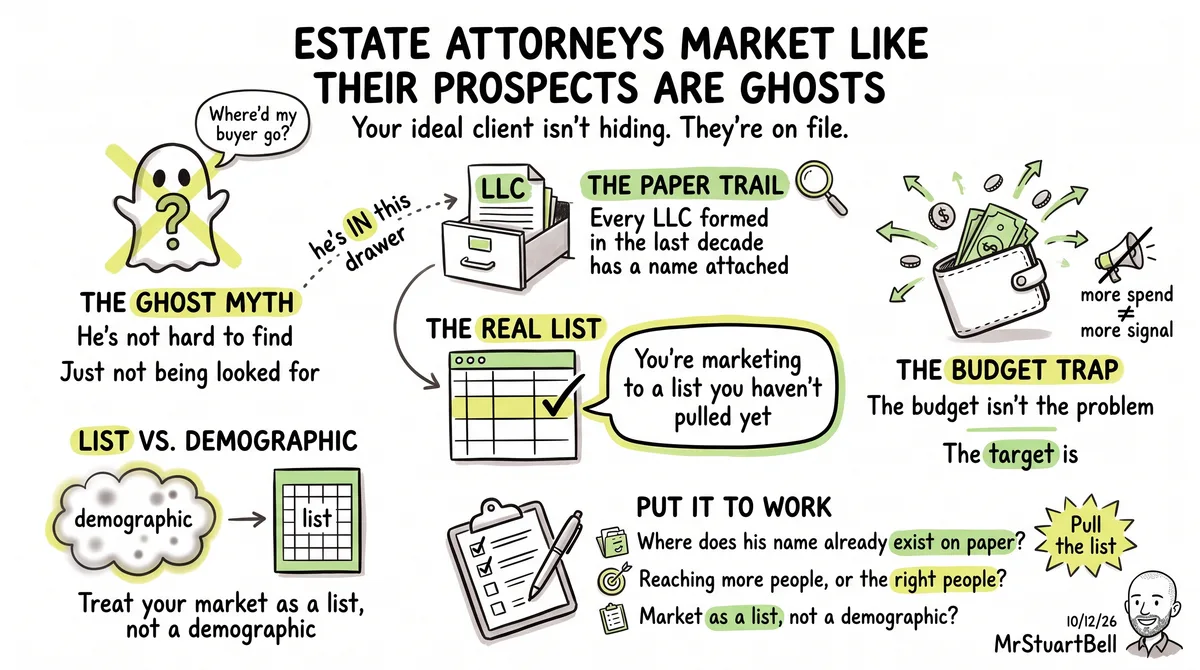
Your ideal client isn't hiding. They're on file.
A personal injury lawyer has no way to find out who's getting into a car wreck next Tuesday. Nobody does. That's not a failure of their marketing department. The buyer doesn't exist yet in any form you could look up, call, or mail something to. So the whole industry built itself around billboards, bus benches, and late-night TV ads. Wide net, because there's no other kind of net available to them.
Estate attorneys inherited that exact playbook anyway. Same local radio spots, same "protect your family's future" seminar invites mailed to anyone with a pulse and a zip code, same broad-reach social ads aimed at nobody in particular. Here's the problem. Their buyer isn't invisible. Their buyer has a name, right now, sitting in a public filing somewhere.
Every LLC formed in the last ten years is in a state database with an owner's name attached to it. Every manufacturing company clearing more than $5M a year is findable through that same kind of public record. Add in the business owners sitting at the edge of a generational handoff, the ones who'll need a succession plan whether they've admitted it to themselves yet or not, and you've got a list. Not a demographic. A list.
You're not marketing to ghosts. You're marketing to a list you haven't pulled yet.
He's not hard to find. He's just not being looked for
Walk into most estate planning firms and ask who their ideal client is, and you'll get an answer like "business owners" or "people with over $2M in assets." True, and useless, because it describes a category instead of naming someone. The LLC that got filed in 2019 has an owner. The manufacturing company clearing $6M has a name on the door and an address attached to the filing. These aren't people you have to go hunting for with a billboard and hope. They're records you can pull with a database search and a revenue filter.
Compare that to the actual competition in this market. The real competitor isn't another attorney. It's the business owner's own belief that a simple will covers everything, right up until the day it doesn't. That belief is what a billboard can't touch and a public record search can. You can't out-advertise ignorance. You can out-find the people who have it.
None of this requires a data team. State business registries already sort by entity type and formation date. Most states publish manufacturing and industrial licensing lists separately from the general business registry, which means you can filter for revenue tier before you've spent a dollar on outreach. A paralegal with an afternoon can build a working list that a billboard company would charge five figures to approximate badly.