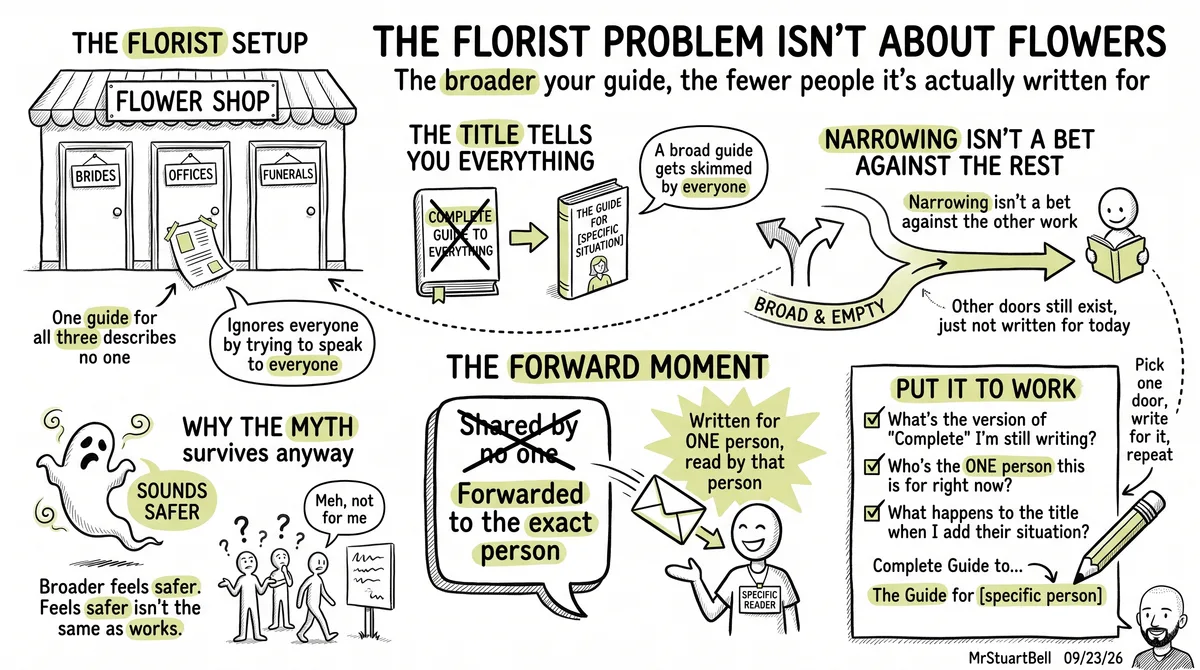
The broader your guide, the fewer people it's actually written for.
A florist I know could serve three completely different customers. Brides planning a wedding. Offices that want a fresh arrangement in the lobby every week. Families ordering something for a funeral. Nervous about picking a lane, she sat down to write a guide and called it "The Complete Flower Buyers Guide."
It described everyone. It reached no one.
The title tells you everything
Here's the myth. More topics, more reach. A wider net catches more fish. It sounds obvious enough that almost nobody questions it, right up until the guide goes out and nothing happens.
"The Complete Flower Buyers Guide" could be about anyone's flower purchase, which means it isn't really about any single person's. A newly engaged bride scrolling her phone doesn't stop for it. Neither does an office manager or a funeral director. The information inside isn't wrong. It's just aimed at nobody in particular, and nobody in particular stops scrolling for a guide that could be for anyone else.
Now put "The North Carolina Guide to Summer Wedding Flowers" next to it. Same florist. Same expertise. A completely different result, because the moment a bride sees her own wedding, her own season, and her own state named in the title, she knows this was written for her specifically. Recommendations beat referrals for the same reason. Specific gets remembered. Vague gets forgotten.
A broad guide gets skimmed by everyone and shared by no one. A narrow one gets forwarded to the exact person it was written for.
Narrowing isn't a bet against the other work
The fear is always the same. If she writes the wedding guide, does she lose the office accounts? The funeral business?
No. She still does that work. She just isn't advertising for it with the same piece of content. Sequencing beats trying to cover everyone at once. Write the wedding guide first, because it's the sharpest, most referable version of what she does. Write the office-arrangement guide next year, for the next audience. Nobody stops calling about weddings because a florist once mentioned funeral arrangements somewhere on her site. But everybody stops calling about anything when the guide sounds like it was written by committee, trying to be relevant to whoever might be reading it.
The same pattern shows up everywhere, from installers who only sell to gas stations to firms that picked one referral partner instead of chasing ten mediocre ones. Specificity isn't a smaller bet. It's the only bet that gets noticed at all.
Why the myth survives anyway
The myth survives because narrowing feels like leaving money on the table. Every florist who's ever sat down to write a niche guide has had the same moment of doubt, staring at a title that only mentions weddings, wondering if she just wrote off two thirds of her business by typing it.
She didn't write off anything. She wrote a title specific enough that the third of her business who needs it right now can't scroll past it. A guide that speaks to everyone gets read by nobody, filed away, forgotten by the time the next post shows up in the feed. A guide that speaks to one bride, in one season, in one state, gets sent straight to her fiance with "look at this, it's exactly us."
That's the part the broad guide never earns. Not reach. A reason to be forwarded.
The florist didn't need a bigger guide. She needed a smaller one, aimed at someone specific enough to recognize themselves in the first line.
Put it to work
What's the version of "Complete" I'm still writing?
Look at your last guide, book, or lead magnet title. If it leans on a word like "Complete," "Ultimate," or "Everything You Need to Know," it's speaking to everyone and reaching no one.
Who's the one person this should be written for right now?
Not your whole customer base. The single group you most want more of this year. Write for them first and sequence the rest.
What happens to the title when I add their specific situation?
Swap the generic noun for their specific one. "Flower Buyers" becomes "Summer Wedding Flowers." "Clients" becomes the name of the exact room they're standing in.