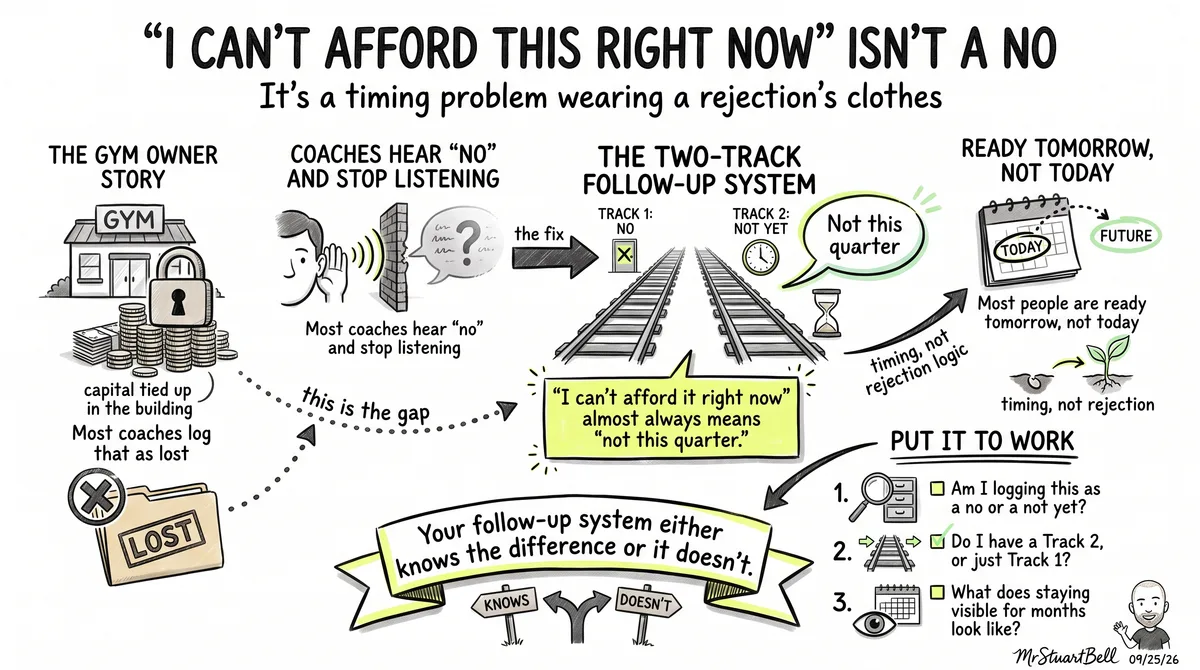
"I can't afford it right now" is a timing problem wearing a rejection's clothes.
"I can't afford this right now."
Eric runs Athletic Evolution, a fitness facility. He wanted coaching. He'd spent his whole career being coached, first as an athlete, now as a business owner who still gets the value of it. When the conversation turned to business coaching, he didn't push back on whether it would work. He said the one thing that gets logged as a no more often than anything else in sales: every dollar he had was tied up in the building itself.
That's not a no. That's a cash flow statement.
Most coaches hear "no" and stop listening
Log Eric's answer as a lost deal and you've made the easiest mistake in the business. You heard "can't afford it" and translated it into "doesn't want it," when what he actually told you was "not this quarter." Those are different sentences with different follow-up requirements, and treating them the same is how you delete a warm lead and call it a sales problem.
The tell is in what people say next. Someone who genuinely isn't interested changes the subject or goes quiet. Someone like Eric keeps talking about the business, the facility, what he'd want out of coaching once the capital frees up. He's not rejecting the idea. He's telling you when to come back.
"I can't afford it right now" almost always means "not this quarter." Your follow-up system either knows the difference or it doesn't.
The Two-Track Follow-Up System names the gap
Most business owners build one follow-up track and let everyone who doesn't fit it go cold. The track they build is for people who are ready now but stalling: a short, structured sequence over a week or two, nudging someone who already wants to buy toward actually doing it. That track works. It's also the only track most owners have.
The second track is the one that gets skipped, and it's the one Eric needed. Long-term prospects who genuinely aren't ready yet don't need urgency. They need to keep hearing from you, consistently, for as long as it takes. Not a five-day push. Something that shows up every couple of weeks for months, sometimes years, so that when Eric's capital finally frees up, you're not a name he half-remembers. You're the call he already knows he's making.
The fix for Eric was never a discount. It wasn't a payment plan pitched into the same call where he'd just told you money was the issue, which reads as pressure, not help. The fix was staying visible on a track built for later. Same message, same value, delivered on a rhythm that matches his timeline instead of yours.