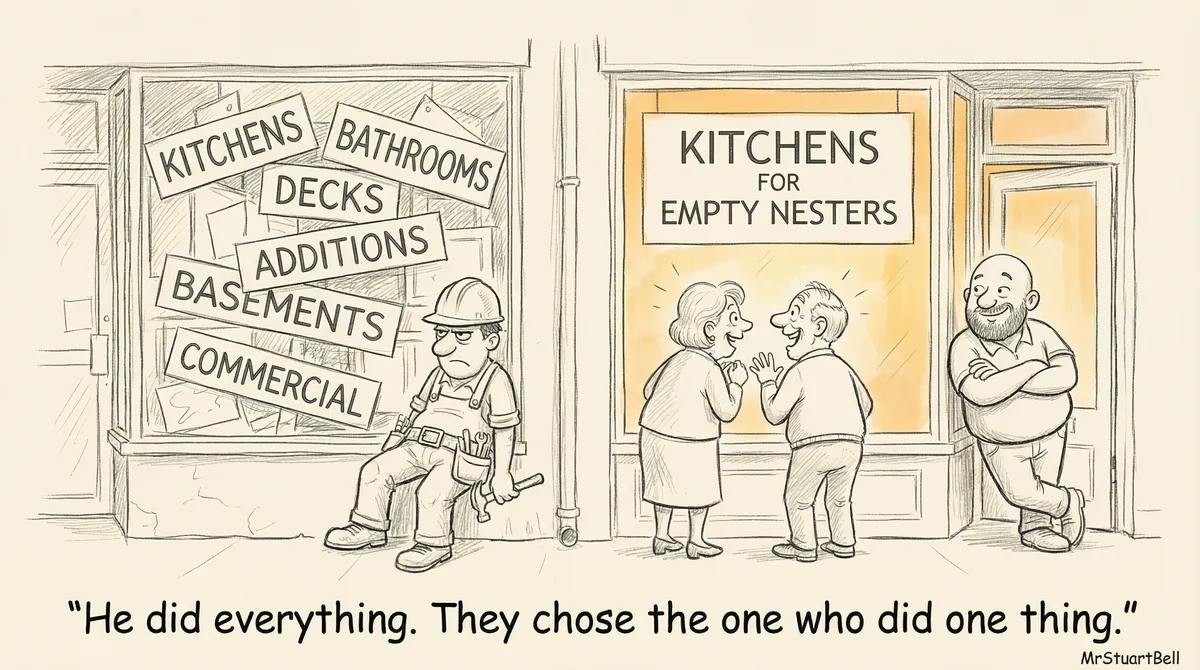
A remodeler told me last year that his biggest source of frustration wasn't the work. It was the phone. It rang, but never for the right jobs. He was quoting basements one week, decks the next, a commercial fit-out the week after that. His website said "We do it all." And that was the problem.
His past clients loved him. They'd refer him in a heartbeat. But when their neighbor mentioned wanting to redo their kitchen, his name didn't come up. Not because they forgot him. Because "I know a guy who does renovations" is too vague to act on. It just floats there and dies.
He picked one person
I asked him a question I ask everyone. "Who do you actually want to be in conversation with?" Not "homeowners." Not "people who need remodeling." One specific person in one specific situation.
He thought about it. His best projects, the ones he loved doing, were kitchen renovations for empty nesters. Couples in their late 50s and 60s whose kids had moved out. The house didn't fit their life anymore. The kitchen was always where they noticed it first.
So he stopped saying "We do it all" and started saying "We do kitchens for empty nesters."
His new line: "Your kids moved out. It's time for that kitchen you actually want."
His referral sources stopped saying "I know a guy who does renovations." They started saying "I know exactly who you should call."
The referral test
That's the difference between a referral and a recommendation. A referral is vague. A recommendation is specific. When someone can say "He does kitchens for empty nesters, that's literally what he does," they're not passing along a name. They're making a case.
Two accountants figured out the same thing when they stopped competing on everything and started owning one thing. The pattern doesn't change across industries. I've seen it play out across hundreds of book funnel projects. The person who narrows gets remembered. The person who does everything gets compared.
He didn't lose the other work
Every remodeler I've had this conversation with asks the same question: "But what about the bathroom jobs? The additions? Won't I lose that work?"
Here's the thing. Nobody stopped calling him about bathrooms. They just started calling about kitchens a lot more. Narrowing doesn't shrink your business. It gives people a reason to pick up the phone in the first place.
His website stopped trying to be a brochure. It spoke to one couple, staring at a kitchen that was designed for a family of five. The book he's working on doesn't talk about remodeling techniques. It talks about what happens when your house doesn't match your life anymore. That's a conversation starter, not a portfolio.
The test is simple
If your referral sources can't finish the sentence "You should call my guy, he..." in under ten words, your message is too broad. That's what makes a smaller audience more powerful, not less.
Pick the person before you write a word, build a page, or run an ad. If it feels uncomfortably narrow, you're probably close.