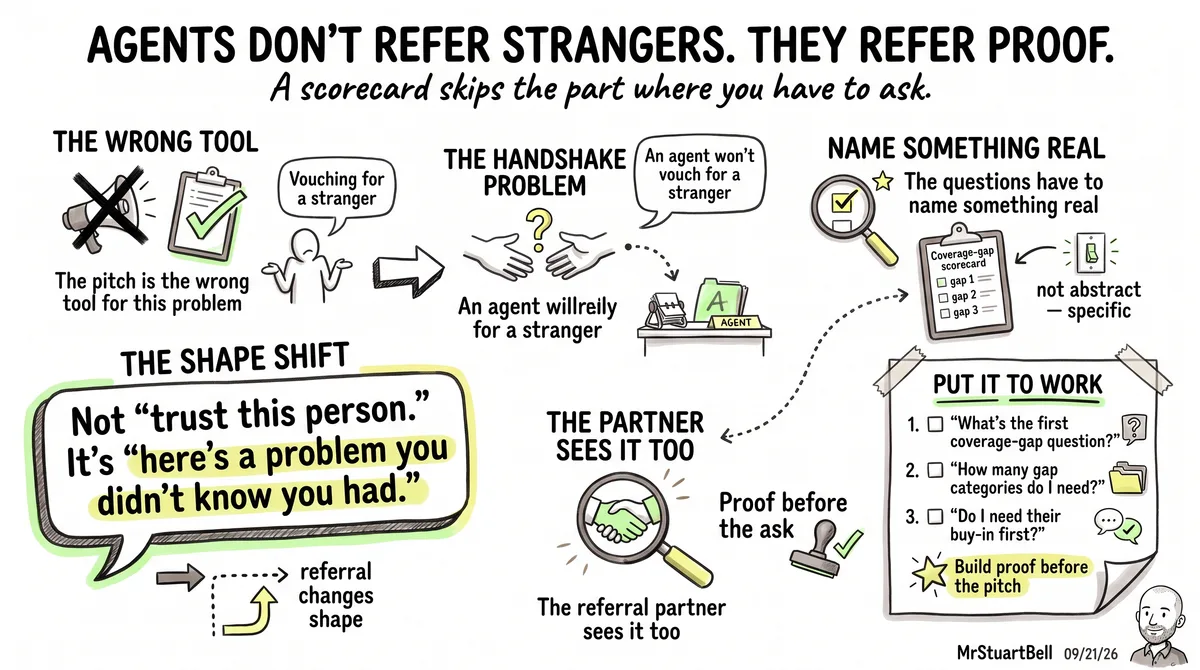
An agent won't vouch for a stranger. A scorecard skips the part where you have to ask them to.
An independent insurance broker told me his growth was stuck at exactly one bottleneck: agents. He wanted a referral network of them, people already sitting across the table from the clients he wanted to reach. Every agent he approached had the same reaction. Polite, distant, gone within a week.
He wasn't bad at pitching. He was solving the wrong problem. The agent doesn't need convincing that he's good. The agent needs a reason to risk a relationship they've already built, and a stranger's word has never been that reason.
Here's the actual math. An agent who hands a client to the wrong person doesn't just lose a referral fee. They lose the client's trust in their own judgment. That's not a risk they're willing to take on a cold pitch, no matter how many years of experience you list.
The pitch is the wrong tool for this problem
A cold pitch asks the agent to vouch for you before you've shown them anything. That's what gets ignored, because it puts all the risk on the agent and all the proof on your word. Flip the order and the ask disappears. A coverage-gap scorecard doesn't ask the agent to trust the broker's claim. It lets the agent's client score their own coverage first, and the client arrives at the gap on their own.
The referral changes shape entirely. It's not "trust this person I'm vouching for." It's "here's someone who already showed you a problem you didn't know you had."
That's the same mechanic as a book funnel, just faster to deploy. The assessment does the proving, so the broker never has to directly ask an agent for trust they haven't earned yet.
The questions have to name something real
A generic "how protected are you" quiz reads as marketing, and agents can smell marketing from across the room. A specific one reads as a diagnosis, and diagnoses are what agents already trust, because spotting a gap the client missed is the exact instinct that makes them good at their own job.
Name the categories instead of gesturing at them. Umbrella liability that never got adjusted after a client bought a second property. Life insurance that hasn't kept pace with ten years of income growth, so a payout that once covered a mortgage now covers half of it. A business policy still sized for a five-person shop that's since grown to twenty. Each one is a specific, checkable fact, not a feeling.
A scorecard closes before you pick up the phone because the client has already seen their own gap by the time anyone dials a number. For a broker chasing agent referrals, that closing happens one step earlier. The gap gets named before the broker and the agent have even had the conversation about working together.
The referral partner sees it too
The other advantage rarely gets mentioned. The agent isn't just watching a client take the scorecard. They're watching the mechanism work. A referral partner handed a real trigger, not a vague pitch, is a partner who can explain what you do in one sentence to the next client who mentions a coverage question. "He's got a two-minute assessment that finds the gap before you even talk to him" is a sentence an agent will actually say. "He's really good at what he does" is not.
The broker who told me about this didn't change his pitch. He replaced it. He stopped asking agents to believe him and started giving their clients something to discover about themselves. The agents who'd gone quiet for months started forwarding the assessment on their own, because sending it made them look good, not because he'd finally found the right words to ask.
Put it to work
What's the first coverage-gap question I should build?
Pick the gap that's easiest for a client to check without calling anyone: a policy amount that hasn't moved while a life circumstance obviously has. Kids, a new mortgage, a second property, a business that's doubled in size. That's a fact, not a feeling, and facts are what make an agent trust the result.
How many gap categories does the scorecard need?
Enough to feel comprehensive, not so many it feels like an audit. Three or four named categories, each with one sharp diagnostic question, beats a fifteen-question form nobody finishes.
Do I need the agent's buy-in before I launch this?
No, and that's the point. Send it to a handful of a friendly agent's clients first. Once the agent sees their own clients coming back with a specific, useful gap identified, the buy-in shows up on its own.