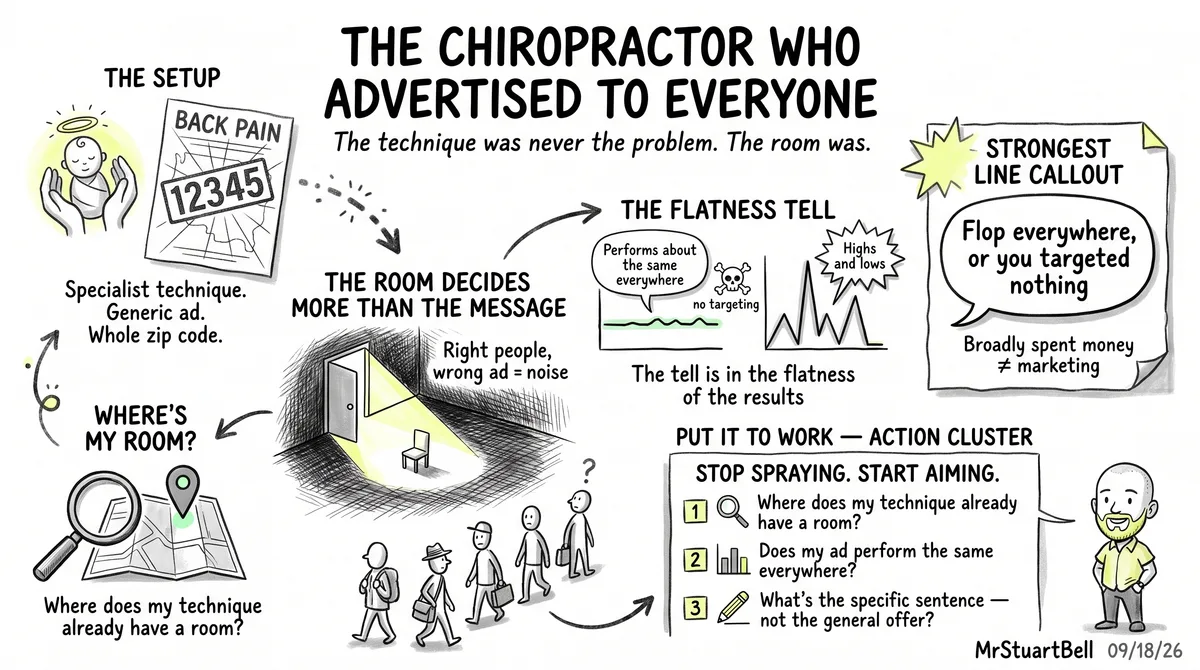
The technique was never the problem. The room was.
A chiropractor client does infant cranial work. Gentle, specific, a niche skill inside an already niche profession. He was running a "back pain relief" ad across his entire zip code, because technically, anyone with a bad back could walk through his door.
The ad wasn't underperforming because of the offer. It wasn't the budget either. He was showing a specific technique to a general audience, and general audiences don't recognize specific value. They scroll past it.
Here's the fix, and it's the same fix that comes up on almost every call like this one. Match the room to the technique, not the technique to the zip code. A chiropractor doing infant cranial work belongs in front of mother-and-baby groups. One who specializes in sports injuries belongs at running clubs and youth leagues, not a general local feed. Same clinical skill, same treatment room, completely different reach, depending only on which room you actually show up in.
The room decides more than the message does
His complementary businesses were never other chiropractors. They were the family doctors down the street, the massage therapists, the pediatrician mothers already trust. A knee surgeon's complementary businesses are sports teams and running clubs, not other surgeons. You're not looking for people who do what you do. You're looking for the places your specific patient already spends time.
A correctly targeted ad should dramatically outperform in the right room and flop everywhere else. If it performs about the same wherever you run it, you haven't targeted anything. You've just spent money broadly and called it marketing.
We tested this once with a cyclist back pain book. "Freeride stretch that slows back pain on the bike" beat a generic version of the same offer by a wide margin, because "freeride" told a very specific rider they were in the right place. Swap in the vague version and the response cratered, even though the underlying offer never changed. Specificity in the ad copy did what the offer alone couldn't.
The tell is in the flatness of the results
Most practitioners assume a broad ad is the safe bet. Wider net, more fish. It's backwards. A broad ad catches nobody's attention because it isn't for anyone in particular. The mother scrolling past a "back pain relief" ad doesn't stop, because her baby doesn't have back pain. She'd stop for an ad about infant fussiness, or colic, or sleep. Same practitioner. Same skill. A completely different sentence.
Ask yourself the question that actually tells you whether you've made this mistake. Does your ad perform about the same everywhere you run it? If a Facebook ad to your whole metro area gets the same click rate as a flyer at a running club, you haven't found the room yet. You've found an average, and averages don't convert. The gap between "flops everywhere" and "dominates in one specific room" is exactly where your ad budget should go. Not more spend. The same spend, aimed at a smaller target with a sharper reason.
This isn't just an ad-placement problem. It's the same discipline that shows up when an installer decides to sell only to gas stations instead of every business in town, or when a firm picks a referral partner it never would have picked by default instead of chasing past clients. It's the same discipline behind narrowing your whole audience instead of trying to speak to everyone at once. The mechanism repeats because it's true everywhere. Narrow doesn't cost you reach. It's what gets you noticed at all.
The chiropractor didn't need a bigger budget. He needed his ad in front of mothers, not a zip code.
Put it to work
Where does my technique already have a room?
Name the group your specific technique serves best, not the general condition it treats. Infant cranial work has mother-and-baby groups. Sports injuries have running clubs and leagues. Find the room before you write the ad.
Does my ad perform the same everywhere I run it?
If yes, you're advertising to an average, not a person. Pull the budget from the flat-performing channels and put it entirely into the one room where your specific patient already gathers.
What's the specific sentence, not the general offer?
"Back pain relief" speaks to nobody. "Gentle adjustments for your newborn's first few months" speaks to one room full of exactly the right people.