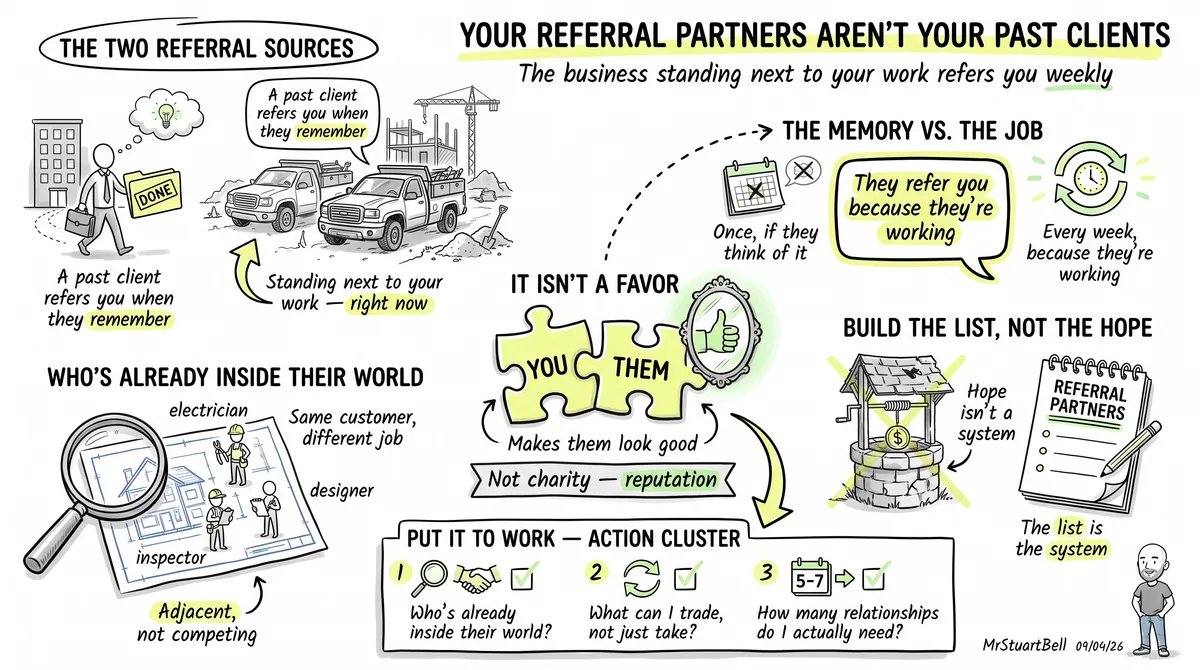
Your best referral source isn't the client you just finished serving. It's the business standing next to your work on someone else's job right now.
An advisor named Bryan built almost his entire book of business on a small group of CPAs and estate attorneys he stays in touch with every month. His return on relationship, the rate his network sends him new business, runs at 15%. The other advisors in his firm, the ones waiting for happy clients to think of them, run at 3%. Same firm. Same license. Same compliance department. Five times the referral rate.
The difference isn't effort. It's where the effort points.
Most professionals build their referral hopes around past clients. Do great work, wait, hope the client remembers you the next time someone in their circle brings up the topic. It's the default because it feels earned. It's also why referrals stay rare. A past client refers you once, maybe twice, only when the topic happens to surface in their own world. They're not structurally in your world. They're not thinking about you unless something reminds them.
A past client refers you when they remember. A complementary business refers you because they're working.
The businesses already standing next to your work
Stuart has watched this pattern hold across industries that have nothing else in common. A chiropractor's complementary businesses are family doctors and massage therapists. A knee surgeon's are sports teams and running clubs. The businesses that already sit inside your customers' world, by design, not by accident.
Take a residential architect. An interior designer is picking finishes on the same project this week. A custom builder needs the plans before they can quote the job. A real estate agent's listing stalls without a renovation estimate to hand the buyer. None of those are past clients. They're structurally inside an architect's world on every single project, not the one year somebody happened to hire one.
That's the whole shift. Past clients throw off a referral moment rarely, and only by luck. Complementary businesses throw one off constantly, because the work itself keeps putting your name in front of them.
It isn't a favor. It's making them look good
The relationship that actually produces referrals isn't "please think of me." That's the same ask behind every elevator pitch nobody remembers. What works instead is giving the complementary business a reason to look good for bringing you in. An interior designer who hands a client a builder that shows up on time and an architect whose drawings don't need three rounds of fixes gets to be the one who "has people." That reputation is worth more to them than any referral fee, and it's the reason they keep doing it.
Myra runs a holistic health practice and figured this out from the other direction. Instead of waiting for referrals to arrive, she sends hardback copies of her book, with a personal note, to the sports medicine doctors and high-end salons already serving her exact patients. She's not asking for anything. She's making it easy for them to look smart the next time a client mentions the problem her book solves.
An architect can run the same play with five named businesses instead of a mailing list of past homeowners. Send the interior designer photos of the finished project before the client's own family sees them. Give the custom builder a heads-up on plans two weeks before they're final, so they're never scrambling to quote. Tell the real estate agent, by name, which listings in their book would benefit from a renovation estimate before they even ask. Every one of those is a reason to be remembered this week, not a favor banked for someday. It's the same principle behind giving referral partners trigger phrases instead of a pitch. Specific and timely beats polished and vague.
Build the list, not the hope
Bryan's return on relationship didn't jump because his clients suddenly liked him more. It jumped because he told a handful of the right people, specifically, why to think of him and kept showing up in their world on a schedule. That's a system. A general "stay top of mind" newsletter to a thousand past clients isn't.
Everyone wants to refer you. Almost nobody knows how, or who to. Stop waiting for the phone to ring because someone happened to remember you. Go find the businesses already standing inside your customers' world, and give them a reason to think of you today, not the one time your name floats up on its own.
Put it to work
How do I find who's already inside my customers' world?
Look at every step your client takes before and after they hire you. Somebody handles the step before yours, somebody handles the step after. Those are your complementary businesses, not your competitors and not your past clients.
What if I don't have anything to offer them in return?
You do. Making them look good in front of a shared client, by showing up on time, communicating early, and doing work they don't have to apologize for, is the payment. It's worth more than a referral fee because it protects their own reputation.
How many of these relationships do I actually need?
Fewer than you think. Three to five businesses that touch your customer's world weekly will outperform a hundred past clients who only think of you once a year, because frequency beats volume every time.