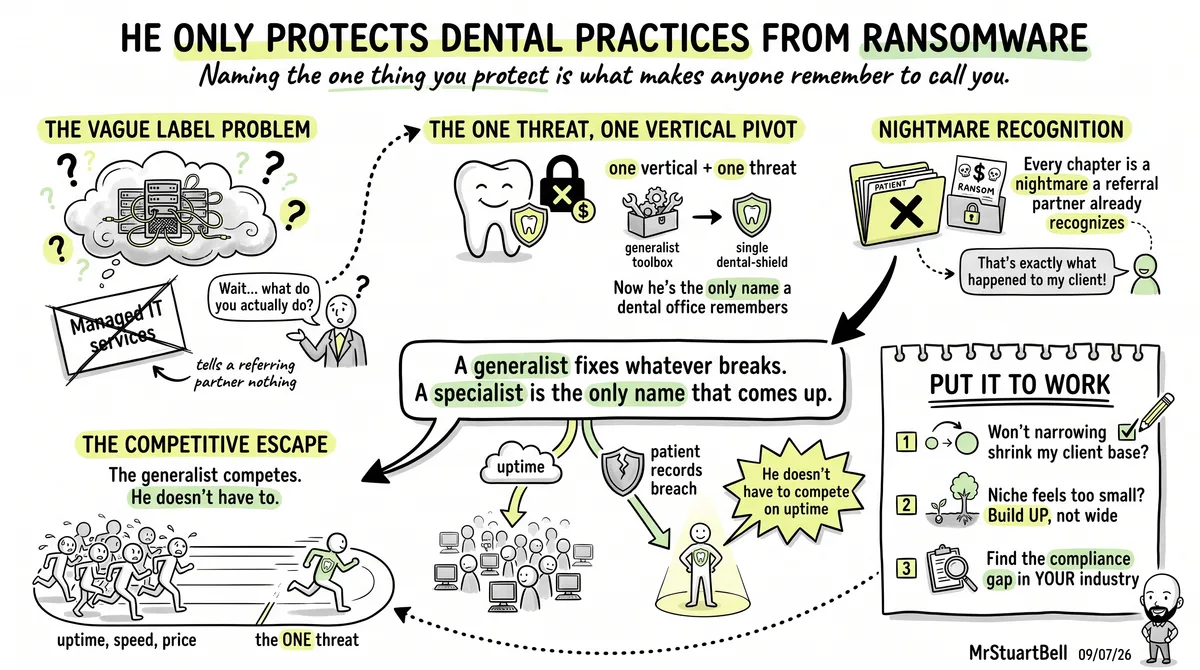
Naming the one thing you protect is what makes anyone remember to call you.
A cybersecurity consultant used to pitch "managed IT services" like every other MSP in his market. Antivirus, backups, a help desk ticket queue, whatever a client needed that month. Then he dropped all of it down to one vertical and one threat: dental practices, protected against ransomware and HIPAA-scope breaches. Nothing else stayed on the homepage.
Dental practices carry the same protected health information a hospital does. Patient records, insurance details, treatment histories, all of it sitting on the same network as the front-desk scheduling software. Most cybersecurity vendors treat a dental office like any other ten-person small business. Firewall, backup, done. They're not wrong that the office is small. They're wrong about what's on the server.
That gap is the whole opportunity. Learning the actual compliance shape of a dental practice, what a HIPAA-scope breach notification requires, what an insurance carrier wants to see after a ransomware incident, takes real work. Most generalist firms won't put in that work for a client this size, because a ten-person dental office doesn't pay enough to justify learning a whole compliance framework for one account. So the ones who do become impossible to compete with, not because the work is exotic, but because almost nobody else bothered to learn it.
A generalist MSP fixes whatever breaks. A specialist is the only name that comes up when the thing that broke was a dental office's patient records.
"Managed IT services" tells a referring partner nothing
A dental billing consultant hears about a breach at a client's office. A dental equipment rep gets asked by an owner who just failed a compliance audit. Neither of them can say "call a managed IT services company." That's not a name, it's a category, and categories don't get referred. They can say "call the guy who only does cybersecurity for dental practices," and that sentence gets a call made the same day.
That's what naming a niche out loud actually buys you. Not a narrower slice of the same market. A specific sentence someone else can say on your behalf. The security camera installer who only sells to gas stations found the same thing from a different door: nobody refers "the guy who does cameras for whoever needs cameras," because there's no sentence in that. There's a sentence in "cybersecurity for dental practices only."
Every chapter is a nightmare a referral partner already recognizes
This is where a 30-chapter Brutal Guide does more than a generic security brochure ever could. Instead of a book explaining cybersecurity in the abstract, each chapter is one scenario a dental practice manager has either lived through or is afraid of living through. A ransomware attack that locks the scheduling system on a Monday morning. A failed compliance audit that turns up unencrypted patient files. An insurance carrier asking for proof of controls before renewing a policy.
None of those chapters teach general IT security. They give the referring partner, and the practice owner, the exact language for the moment they'd need to call. That's the mechanism. A specific scenario is a conversation starter. A list of services is a shrug.
The generalist competes on uptime. He doesn't have to.
A firm still selling "managed IT services" is asking every prospect to compare price and response time, because that's the only thing left to compare once the positioning says nothing specific. The specialist skips that comparison entirely. He's not one option among several IT vendors. He's the only name that matches the specific nightmare a dental office manager just described out loud.
He still turns down work outside dental. That's fine. The work he keeps is the work nobody else bothered to learn how to do.
The consultant who dropped "managed IT services" for "cybersecurity for dental practices only" didn't shrink his pitch. He gave the only people who'd ever refer him something they could actually say.
Put it to work
Won't narrowing to one vertical shrink my client base?
It narrows who you lead with, not who you're allowed to serve. The businesses in your named niche now have a specific reason to call you first. Everyone else still finds you, they just aren't the headline anymore.
What if my niche feels too small to build a whole business on?
Dental practices alone run in the tens of thousands in the US. You don't need all of them. You need to be the only name that comes up in the specific rooms where dental practice managers talk to each other about their last bad IT experience.
How do I find the compliance gap in my own industry?
Look for the client segment every generalist competitor treats as an afterthought because the compliance work is genuinely harder than the rest of their book of business. That's not a reason to avoid it. It's the reason nobody else is there once you learn it.