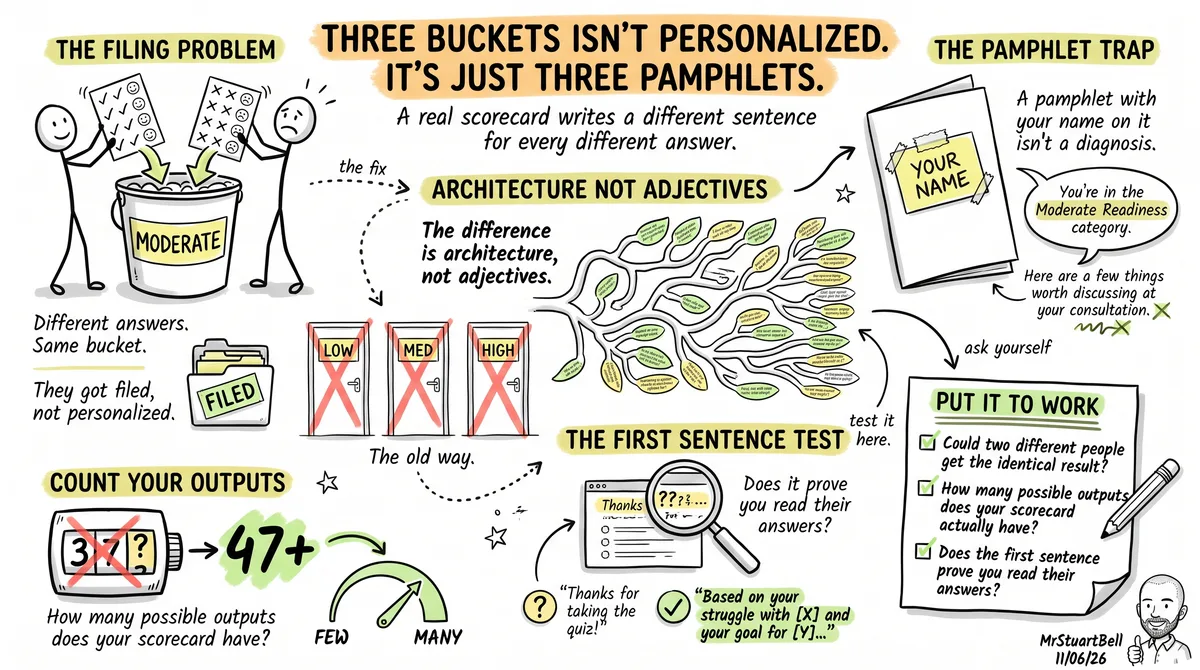
Two people who answer every question on a scorecard differently and land in the same bucket didn't get personalized. They got filed.
A teenager walks into an orthodontist's treatment-readiness scorecard with mild crowding and nothing else going on. A working adult takes the same scorecard with a bite issue that's been bothering him for years and a wedding in four months. Different ages, different problems, different urgency. Score them both and there's a real chance they land in the same "moderate" bucket. There's an equally real chance they get handed the exact same paragraph back.
That's the myth. Most scorecards call that personalized. It isn't. It's sorting, with better production values than a paper form.
A pamphlet with your name on it isn't a diagnosis
Here's what the two versions actually look like side by side, because the difference doesn't show up on the sales page. It shows up on the result screen.
The bucket version: "You're in the Moderate Readiness category. Here are a few things worth discussing at your consultation."
The answer-specific version: "You're dealing with a bite issue that's been bothering you for years, and you've got four months before a wedding. That timeline changes what's realistic. Here's what that specific combination means for your options."
Read them back to back. The first one could have gone to anyone wearing the "Moderate" label this week. Nobody else got the second one, because nobody else answered the way the working adult did.
The difference is architecture, not adjectives
This isn't a copywriting problem you fix by hiring a better writer for the bucket paragraphs. It's an architecture problem. A bucket-based tool maps a score range to one of a handful of pre-written outcomes, written once, shipped forever. However many questions it asks on the way in, the output only ever has as many shapes as somebody wrote templates for.
A genuinely personalized scorecard works the other way. I've watched this live on the backend: a prospect answers eight questions, the advisor gets a notification, and what comes back isn't pulled off a shelf. It's a result generated from the actual combination of those eight answers, with coaching notes that shift depending on exactly where the gaps showed up. Change one answer and the sentence changes with it.
That's the part that doesn't survive the "we personalize our results" claim most tools make on their sales page. Personalize is doing a lot of work in that sentence. If the personalization tops out at five or six possible outcomes, it isn't describing the respondent. It's describing which door they walked through.
A result that's identical for everyone in a bucket isn't a diagnosis. It's a form letter wearing a lab coat.
Why the first sentence matters more than the rest of the scorecard
I wrote about this same gap on Dean Jackson's Profit Activator Scorecard, where a sentence built from one agency owner's actual answers landed harder than any bucket label ever could. A scorecard already closes before the phone rings when it works right, but only if what it closes with was actually built for the person reading it. That's the real line between a scorecard and a quiz. A quiz can only ever tell someone which label they earned.
A prospect who gets a generic bucket result registers it, without consciously deciding to, as a form. The whole point of a scorecard is to feel like a diagnosis instead. They don't need to understand the architecture behind that feeling to notice when it's missing.
The teenager with mild crowding and the working adult racing a wedding date should never read the same paragraph. If they do, the scorecard just told them, in its very first sentence, that it wasn't really looking.
Put it to work
Could two different people get the identical result from your scorecard?
Pull two completed results and read them side by side. If you could swap the names and nothing would read wrong, you built buckets.
How many possible outputs does your scorecard actually have?
Count the templates. If that number is smaller than the number of meaningfully different answer combinations your questions allow, you've got a ceiling you haven't noticed yet.
Does the first sentence of the result prove you read their answers?
That sentence is the whole pitch. If it could open with anyone's name in place of theirs, rewrite it.