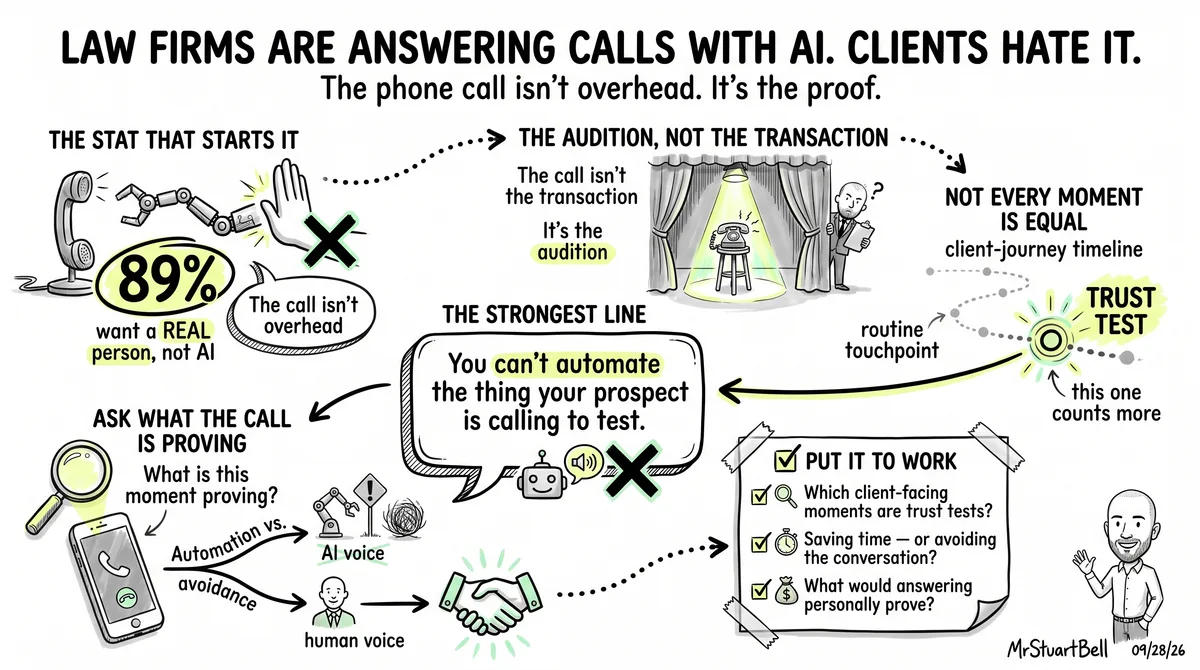
The phone call isn't overhead. It's the proof.
LEX Reception surveyed 6,000 consumers this September and asked how they feel about AI answering the phone at a law firm. 89% said they'd rather talk to a real person. That's up from 84% a year ago. And 57% said heavy AI use in client service would make them trust the business less, not more.
Law firms are buying AI answering services anyway. Family law and personal injury firms lead the adoption, because an after-hours lead that goes unanswered is a lead that calls the next firm on the list. The math looks obvious from the firm's side. Missed calls cost money. AI never misses a call.
That math only works if you ignore what the call is actually for.
You can't automate the thing your prospect is calling to test.
The call isn't the transaction. It's the audition
A prospect calling a personal injury firm at 9pm isn't checking office hours. They're scared, or hurt, or both, and they're testing whether this firm will actually take care of them. That test can't be passed by a script that sounds calm because it doesn't feel anything.
The Agentic Trust Loop explains why the AI receptionist trend keeps happening anyway. Prospects already delegate the research stage to AI. They ask ChatGPT to shortlist firms, read reviews, compare specialties. That's Delegation 1, and it's fine. AI does research well. But somewhere between the shortlist and the retainer, the prospect needs a human to confirm what the research suggested. That's Reclamation, and it happens on the phone.
Hand Reclamation to a bot and you haven't saved the call. You've failed it.
Not every moment on the client journey is equal
The fix isn't "never use AI in intake." Scheduling, reminders, intake forms, all of that can run on automation without anyone noticing or caring. Nobody's testing your trustworthiness through a calendar link.
The first live conversation with someone who's scared, angry, or grieving is different. That's the one moment where automating the interaction removes the exact thing the prospect called to find. If the call itself is proof you take the problem seriously, handing the call to AI doesn't just cut labor cost. It cuts the proof.
You already know your phone is a trust signal, even when you can't say why. Familiar on the first call isn't just about what you say when someone picks up. It's about the fact that a person picked up. The lawyer who answers personally, or has a real person on the line within a ring or two, is running a more expensive operation than the firm with the AI answering service. That expense is the point. It's visible. The prospect can feel the difference between "we built a system to be reachable" and "we built a system to avoid you."
Ask what the call is proving
Before you route your intake through AI, ask what that specific call is proving to the person on the other end. A scheduling confirmation proves nothing except that your calendar works. A first call from someone deciding whether to trust you with a lawsuit, a diagnosis, or a divorce proves everything.
This isn't unique to law firms. Your prospects are already running you through AI before they call, and they'll do it again after. The one moment they can't outsource, the moment they're deciding whether the person on the other end actually gets it, is the moment AI can't stand in for you. Automate around that moment all you want. Just don't automate the moment itself.
The firms buying AI answering services to save money on the phone are optimizing the wrong line item. The call was never overhead. It's the whole pitch.
Put it to work
Which of my client-facing moments are actually trust tests?
List every touchpoint, from first contact to signed engagement, and mark which ones a prospect would notice being automated. Those are the ones you protect.
Am I automating to save time or to avoid the conversation?
If the honest answer is "I don't love making that call either," that's worth sitting with before you buy the tool.
What would it cost me to answer personally, and what would it prove?
Compare that cost to what you're currently spending to be "efficient." The trust you'd buy back might be worth more than the minutes you'd save.