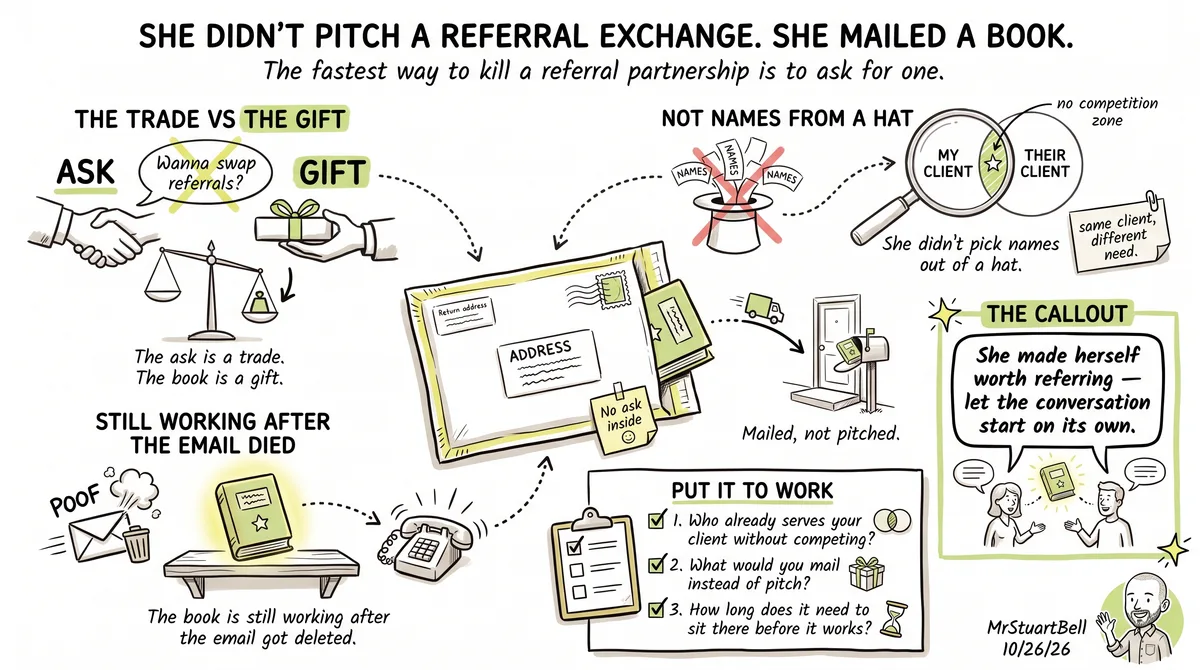
The fastest way to kill a referral partnership is to ask for one.
Myra runs a holistic health practice. A year ago she wanted referrals from the businesses two blocks over, the sports medicine doctors and the high-end salons who already serve the same clients she wants, without competing for a single one of them.
Most practitioners in that spot send an email. "I'd love to send you my overflow if you'll send me yours." It's a fair trade on paper. In practice it's a favor, and favors get forgotten the moment the inbox fills up again.
Myra skipped the ask. She mailed each one a hardback copy of her book, with a personal note. No pitch for a reciprocal arrangement, no "let's grab coffee and talk partnership." Just her name on something useful, landing on a desk before anyone owed her anything.
She didn't ask to be referred. She made herself worth referring, and let the conversation start on its own.
The ask is a trade. The book is a gift.
A referral-exchange pitch asks someone to do you a favor before they know anything about you beyond your email signature. They have no proof you're good at what you do, only your word for it, and now you want them to put their own reputation behind a referral to a client they care about.
People want to refer you. Most of them just haven't been handed anything to refer with. Myra's book did the proving before the asking. By the time a sports medicine doctor finished the note and skimmed a chapter, they'd already formed an opinion about whether she knew what she was talking about. Nobody had to take that on faith.
She didn't pick names out of a hat
Myra's list wasn't random, and that's most of why it worked. She picked three kinds of businesses, each one already inside the world of the client she wanted:
- Other holistic practices, who see the overflow she'd love to take
- Sports medicine doctors, whose patients ask about recovery options she handles
- High-end salons, whose clients already spend on themselves the way her patients do
None of them compete with her for a client. All of them already have a reason to care what she knows, because their own clients keep bringing it up.
That's the filter most people skip. They send their referral pitch to anyone who'll take a meeting, a competitor, a stranger, a business that has no reason to trust them yet. Myra only mailed the book to people who already had a client in front of them asking the exact question she answers for a living. The targeting did half the work before the book even arrived.
The book is still working after the email got deleted
A hardback sitting on a desk doesn't disappear the way a cold pitch does. One 90-Minute Books client uses her physical copies the same way, not for cold outreach but inside consultations, pulling one out to reinforce a point she already made out loud. The book does double duty. It's proof before the conversation and a reference during it.
Weeks after Myra's note arrived, her book is still sitting where she left it. A stranger's email pitching a reciprocal referral arrangement is in the trash, forgotten by lunchtime. Everyone wants to refer you. Most people never give them a reason to remember how.
That's the real cost of leading with the ask. Not that people say no. It's that most of them never had a reason to say yes in the first place.
Myra never asked for the referral. She just made sure she'd already earned it by the time anyone thought to send one.
Put it to work
Who already serves your client without competing for them?
Name three. Not categories, names. The chiropractor down the street, the estate attorney two floors up, the specific person, not the profession.
What would you mail instead of what you'd pitch?
A book, a case study, a one-pager with your name on it. Something real enough to sit on a desk for weeks, not something that lives and dies in an inbox.
How long does it need to sit there before it starts working?
Longer than you'd think, and it keeps working the whole time you're not thinking about it.