Chapters
Show Highlights
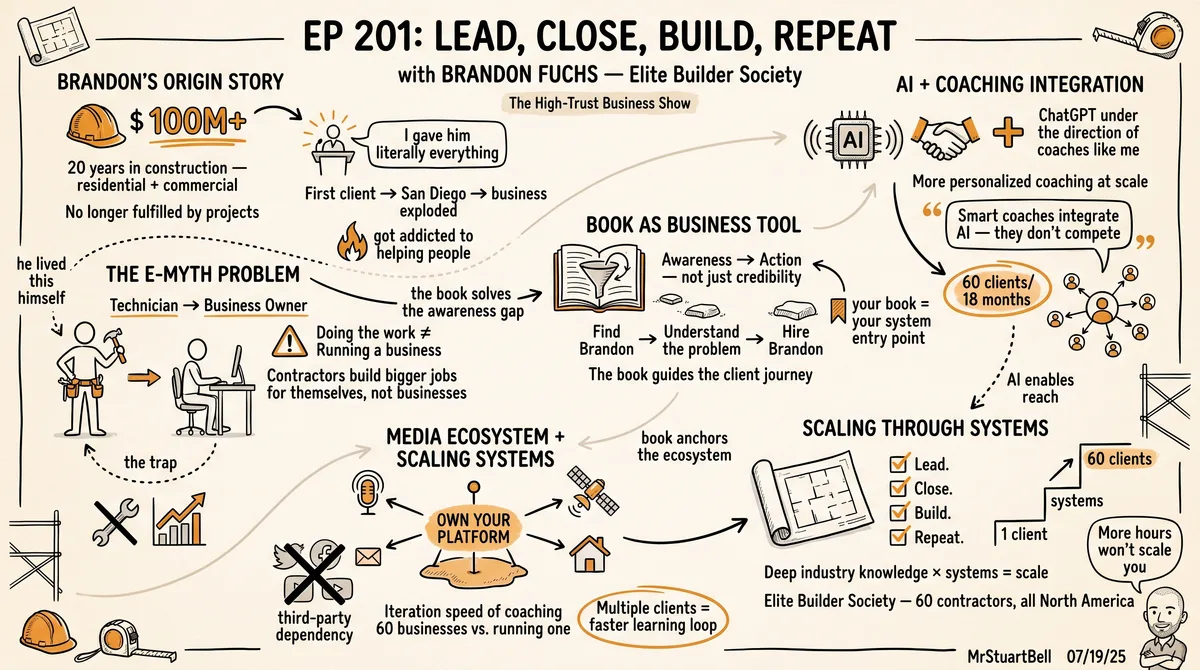
- Smart coaches will integrate AI into their coaching rather than compete against it
- Coaching multiple businesses accelerates your learning faster than running just one
- Your book should guide client journeys from awareness to action, not just establish credibility
- Building your own media ecosystem beats relying entirely on third-party platforms
- The E-Myth problem hits contractors hard when they go from technician to business owner
- AI tools like ChatGPT can create more personalized coaching experiences at scale
Some coaches think AI will replace them. Brandon Fuchs thinks the smart ones will use it to get better at what they already do.
Brandon went from two decades in construction to coaching 60 contractors across North America in just 18 months. His secret isn't just construction expertise, it's how he's combining that knowledge with AI tools to create scalable coaching systems.
I talked with Brandon about his transition from doing $100 million worth of construction projects to helping contractors build businesses instead of just bigger jobs for themselves. He walked me through how he's using ChatGPT not to replace coaching, but to make his coaching more personalized and available to more people.
We covered how his book fits into this model, why he's building his own media ecosystem instead of relying on social platforms, and how the iteration speed of coaching multiple businesses gives you insights you'd never get working solo. Brandon's approach shows what happens when you take deep industry knowledge and scale it through systems instead of just more hours.
Transcript
AI transcript provided as supporting material and may contain errors.
"Well, I think ChatGPT and AI will be coaching people in the future and it won't be doing it on its own. It will be doing it under the direction of people like me. The smart coaches that really understand how to use AI will integrate that into how they coach their people."
Stuart: Everyone, welcome back to another episode of the book More Show. It's still Bell here and today joined by Brandon Fuchs. Brandon, how's it going buddy?
Brandon Fuchs: Great man, thanks for having me.
Stuart: Ah, real pleasure. It's. I always say when we're talking to authors it's always great to. If I haven't had a chance to speak to you before, it's always great to put that kind of the bits and pieces that I've got from seeing the book process go through with the team to the real person and then dive underneath the surface a little bit. So excited to share that with everyone. Let's start by getting everyone else up to speed, then give us the background on what it is that you do in the organization and then we'll get into the book.
Brandon Fuchs: I am the founder, president and founder of the Elite Builder Society Prior which, which has been running for about a year and a half. Prior to that I've got about two decades of high end residential and commercial construction experience. I've, I've probably executed well over $100 million worth of projects in my life. I've also worked industrial and I got to a point in my career in the construction space where I was no longer like fulfilled by, by the projects, so to speak. Which sounds crazy to a lot of people, even the people that I coach today. But I just, I was no longer fulfilled and that's the end of it. And I, I shifted to mentoring people and the first person that I mentored, he was out of the U.S. he's from San Diego and he's like, hey, would you help us set up our company? And I said, well you're no non conflicting to me so I mean it doesn't hurt me to do this.
Stuart: Yeah.
Brandon Fuchs: And I said sure, I'll do it. And so I took everything I learned from construction from doing, which I was really, really good at by the way, and then implemented that into his business, shared with him all of these tools without concern. I just, without any reservations, without holding back, I just gave him literally everything I possibly could. And his business exploded in a short period of time very, very quickly. And then I got addicted to helping people. So then I entered into, I entered into coaching full time about a year and a half ago and I'M currently coaching almost 60 people personally through in the contracting space all across North America. All across North America, yeah.
Stuart: And mainly construction contracting or contractors.
Brandon Fuchs: Yeah, they're primarily general. General con. Yeah, general contractors. Some subcontractors like electricians, plumbers, H Vac guys, but mostly general contractors and kind of larger renovators doing you know, five, five hundred thousand dollars projects. You know, even the small guys that are, that are just starting out doing a smaller projects we've had some great success with. So yeah, that, that kind of forced me into the creative of this book which we're going to dive into.
Stuart: That whole helping the contractor side of things just strikes me the E Myth problem, that old Michael Gerber book. If someone's an expert in what they do and then they branch out from working from someone else to starting their own business and they immediately run up against this idea of they're a technical professional, but they're not necessarily business builder. And that's when it all starts falling to the side and you just create a bigger job for yourself than a business. So I imagine that the guys who are working with you really see that amplified return because not only are they the experts in what they do, but now you bring in that structure and experience and expertise. So I guess it really allows them to take off a lot more than just trying to trial and error it themselves.
Brandon Fuchs: Really what happens is, I mean, you know this, you've been in this, the book industry for how long? How long have you been doing this for?
Stuart: Yeah, like 15 years now.
Brandon Fuchs: Yeah. So if I were to start in the book industry on day one. Right. And you're on year 15, you have a, a more in depth understanding of the wins and losses that experienced along the way that have shaped and crafted your decision approach on how to provide services for clients just like me. Right. And it's the same thing in construction and marketing your business. The, the crazy part is that because now I'm hyper focused on coaching people, it's now amplified even greater because now I'm not just using what I've learned and what I've succeeded with, I'm actually using what they're learning and what they're succeeding with. And so I'm actually becoming, I find myself to becoming. I'm not trying to like prop an ego around this, but like I, I have a very, very in depth understanding of what it takes to be successful in this industry. What more so than I ever did even before. Because now implementation with so many people has proven it time and time again and it's the same thing with you. Like if you were to coach somebody into how to build a book writing business, guaranteed their success in parallel with your success would be completely different. Right. If you started your business on day one like you did and they started their business on day one but they, you implement everything you've learned.
Stuart: Yeah.
Brandon Fuchs: Into their business, they're going to surpass you like within the first six months.
Stuart: Right. It's so funny, isn't it? Particularly when you come in with a framework and that framework you then get to apply at scale and the, the speed of iteration of thinking through that framework and how it applies to the different things but also without the baggage of having to do the day to day delivery that they're. They're delivering. You can just concentrate on that opportunity and the strategic view and then seeing it through the lens that you've got and at the scale of all of the different businesses it really allows you to kind of refine that thinking. The framework that we use for the books, I mean each book's different but there's definitely the underlying and 90 minute book is very specifically a thing we try and bring that framework because we know it's the most effective way to start conversations. It's not people get caught up in the traditional book world or what they think should be in a book and not necessarily what the outcome is because again when you say book you think of like a Barnes and Noble shelf more than you do a Google Ad. But in reality.
Brandon Fuchs: But also, but also that that tactic came from trial and error. Right. You didn't just wake up 15 years ago or however long ago and said this is the exact framework that will produce a successful book. It came from time to. And what I do is similar to you, you know, but I took my time or I take my time and my experience and I give, I give it to everyone that I work with without any, without holding back. It just catapults them to another level so quickly.
Stuart: It's interesting coming with that kind of like abundance view. A lot of the people listening here will be strategic coach clients or coach adjacent for in that part of the world and the whole kind of abund abundance mentality that's in that space in Genius Network we've got a big crossover with those guys as well. But this whole idea of abundance versus scarcity, I think in the micro level people fear and think oh if I'm building this house or if I've got this electrical job, it's a zero sum game that means that someone else doesn't Therefore, I have to take something away from someone else in order to get this thing. But as soon as you step away from that one individual task to the bigger picture, it really is a very abundant world that we live in and I think there's, we'll get into some of the AI stuff in a little bit because it's pretty fundamental to what we're both doing. But there's a fear and a scarcity around the AI world that the robots are taking the jobs and this means that the humans will lose out when. What it really means is that the robots are allowing humans to amplify. And just as moving from the kind of agricultural to industrial age machines kind of humans didn't suffer, it kind of amplified the opportunity. It's the same with what you're talking about. Coaching. The ability to give everything and it's an amplifying world. It's not a. You don't feel like you need to hold back at all because there's more than enough work for everyone out there.
Brandon Fuchs: Yeah, well, I, I think ChatGPT and AI will be coaching people in the future and it won't be doing it on its own. It will be doing it under the direction of people like me. The smart coaches that really understand how to use AI will integrate that into how they coach their people because literally, like, I mean, this isn't really a great comparison because people can't really conceptualize what this looks like. But AI is like the creation of fire. It's mind blowing and it's transformational. Fire changed the world, right? AI will change the world. Not with robots. I mean, robots are going to come at some point, but they're going to be doing the inefficient tasks that humans are forced to have to deal with. That makes us inefficient. The world moves faster each and every day because the, the objective is to systemize and optimize your life. Right. That's what AI really is best used for. It's not to replace anyone, it's to replace inefficienc and inaccuracies.
Stuart: Yeah.
Brandon Fuchs: And I think the, you know, like my son, I talk about this quite a bit anytime the word AI comes up. He just finished grade 11 and at the beginning of his first semester, he ended up getting a zero on an assignment because the teacher said, well, we scanned your assignment and it said you used AI. And he. And his mother was like, well, you know, you shouldn't be using AI. It's cheating. And I'm like, no, you should be using AI. Because if you don't know how to use AI when you leave high school, you'll have no idea how to live, you know. And so I got in a bit of a. Not an argument, but a conversation with his teacher, and they didn't know how to use it, which is the scariest part. And I explained to the teacher, I was like, this is the framework on how I teach my kids how to use AI. They don't cheat. They use it as a resource tool to create more efficiency, more accuracy, and faster execution so they could complete things at a higher level and retain more information. And the teacher was floored that we were like that, integrated with it. We're not just saying, please answer this question right. You know, it's more detailed so that you understand. And I said, you know, you really should have gave him 110% because his assignment was perfect, because that's the execution rate that you should be striving for. Like, greatness should try to be the greatest. If you asked him back later about his assignment, he would be able to respond and basically provide that level of depth that he gathered from it, and that shows that he knows what he's doing. It didn't. Didn't take it away. So AI is important.
Stuart: Yeah. And it's interesting that with every new technology, I guess there's the people who are with everything in life generally, there are people who are quick changes and enjoy change and people who at the other end of the spectrum don't want any change whatsoever. And that kind of manifests itself in every single way. And the idea that AI is the problem, when actually AI is the category, it's like saying electricity is the problem. Well, okay, if electricity is keeping the lights on at night so you can do something, that's not a problem. If electricity is shocking you because something's poorly installed and it's electrocuting people, that's a problem. But electricity is not the problem. It's always difficult. And again, this sentence might get this podcast flagged somewhere, but it's a bit difficult because it's triggering. Like the guns kill people or do people kill people? And that's kind of. I'm intentionally using that example because it's. It's emotionally driving because you've got people at vary both ends of the spectrum. But the question. At least address the question in your own mind. Pick whichever answer you want. It's. It's up to you. But least address the question AI in that school environment. If the. If your son had just gone in and put a one shot Prompt and got some words out and never edited it, just stuck out in a document and submitted it, that's a problem. But if he spent seven hours researching and went to the breadth and depth of three levels deeper than all of his colleagues went to, schoolmates went to, that's not a problem at all. So it's this idea that just labeling something to kind of get back, I guess the guys that you work with labeling contractors a problem because someone had a bad experience here. Well, that's very different from the person that you're working with, where, yes, they're a contractor, but their, the experience that their clients have are completely different. So, yeah, this labeling thing, it's, it's.
Brandon Fuchs: Yeah, you know, and then the, the craziest part is you'll see another book, we'll be writing another book. Because that moment with that teacher triggered me to do something more. So I, I officially downloaded Chad GPT. I'm gonna say two years ago, not that long ago, right? Somebody, I was at a networking event, somebody said, hey, you should check this out. And I'm like, what the heck is this? And I downloaded it and I went in and I was like, tell me something cool, you know? And that was it. And then I was like, huh, I really knew something. And then I just kept going and it was like, I remember. So I'm 43 years old and I remember when a calculator was introduced in school and we were frowned upon by using the calculator. And I was just like, but why? But why? Like, I, I'm so much more efficient and I'm so much more, you know, my responses are better, everything's more accurate. And it was the same kind of feeling when I touched chat GBT as the feeling when I touched the calculator. I was like, wow, this is cool, you know, And I mean, from there to now, where, where my grasp of what we can do with AI is just on another level. Like that individual situation with my son's teacher catapulted me to create an educational tool that I'm like, going to be launching in probably the next six to eight months, which will be revolutionary to say the least.
Stuart: So let's talk about that bridge then, and we'll talk about the book as well. So the contractors wouldn't necessarily be the first group of people that you'd think about as using technology or AI tools to leverage their business, because you tend to think of, okay, that's programmers and office workers. That's the group to be most impacted. But contractors physically working with Their hands, what's the opportunity? But I mean, obviously you and I both know there's a huge opportunity for them, particularly probably on the stuff that they're least enthusiastic about doing, which isn't the hands on work. So talk a little bit about this bridge now that you've got between your AI world and what you're trying to introduce to the contractors and how that all ties together to make them more effective.
Brandon Fuchs: So contractors can be. There's several different types of contractors. I have been all of them. I've been the guy that builds everything. I've built custom kitchens on my own, I've built a home on my own. I framed houses, I've done foundations. So I've done all of the on site stuff. Right. And then I've also ran the. I've worked as an employee managing people for somebody else. I managed 100 people, super, super young. And so that's a different level. So you got the guy on site doing it, you got the guys that are just, you know, the employees managing other people for somebody else. And then you've got the business owner. Right? And so the business owner is forever trying to figure out how to make more money and how to become more efficient and how to stay relevant in the world. And the craziest part is if you ask ChatGPT, even on a very low level, how do I do X, Y and Z? It will give you a response. So the most successful people are the ones that converse with somebody and problem solve together. Right? They problem solve, they have situations, they're pulling, they're asking, they're, they're. I literally, whether it might be psychotic or not, I think the best entrepreneurs are a little bit crazy. And I got into a deep dive with my chatgpt to the point where I named it, I gave it a name and it continued on and it started sourcing. And as the versions continued to increase and continue to improve, it started giving me better problem solving responses.
Stuart: Yeah.
Brandon Fuchs: And so the merger between construction and really, it doesn't matter. The merger between ChatGPT and Every Business is problem solving inefficiency. And so what I'm doing is most of the cases, the contractors that I work with have just downloaded ChatGPT or have no idea what it is and we dive into it right from the beginning. We use ChatGPT regularly to help them problem solve so that they can do it on their own. Right. It's like having a brilliant assistant that is at your beck and call for almost for free. I have the paid version, I'd highly recommend you get the paid version, but almost for free and you can ask some questions 24 hours a day. So if you're a psycho entrepreneur that is hyper focused on not necessarily working, I don't call it like, you know, like I love what I do. So I'm not working, I'm doing what I love and so it doesn't become, you know, a nuisance or an inconvenience. It's just a part of my day to day.
Stuart: Right.
Brandon Fuchs: It's every day is an exciting opportunity. I get to wake up and do something great. And every day, shockingly, it's moving so much faster. Like what I've built with my coaching company in a year and a half is mind boggling to most coaches. We have hit well over $100,000 months in a year and a half. Most of them have, you know, hitting, they're hitting anywhere between 10 to 20 thousand dollars. We were there within our first like two or three months and we didn't do that with, you know, without ChatGPT. ChatGPT helped us solve the problems that we are facing as we're navigating the growth of the business. And so what we do with contractors is the same thing. We just help them with tools and tactics that we've built. We help them integrate these tactics into their business that set them apart from their competitors very quickly.
Stuart: Yeah, that point that it's an active conversation with a partner who is trying to be as helpful as possible and has limitless knowledge. And as the partner understands you more, the AI model understands you more, its answers get more and more and more relevant to you. But the point that you made about the calculator earlier, and I've got a couple of years on you just turned 50 this year, but similar deal can. Remember when calculators were super frowned upon because everyone was saying no, you need to know what you need to know how it works, the underlying piece. And I think that's going to be the difference with everyone's going to be using AI tools in the future. They're going to be ubiquitous. But there is going to be a difference between those who do it effectively and less effectively. And like the example of the homework, if people are just trying to one question, one shot it you may, you'll get an answer, it'll probably be reasonable. But the people who learn to converse with it and know what they're actually trying to do. So your contractors, they know the business so they know that if they get a response that they can tell if it's Going the rails a little bit if it's not quite either interpreted the question correctly or given the right answer, but within two or three conversations you can really dial it in and then it really gets laser focused and adding to your knowledge, it's just prompting you and giving you anchor points for more conversations or more opportunities or more ways and reasons to reach out to people. So that skill of being the discussion partner, of understanding that, okay, I'm not necessarily going here for the answer, I'm going here for a discussion on what the answer could be, that is a big game changer. So for your guys, you're saying that often these people are just exploring these tools for the first time. Is there pushback or they're excited about this idea? Are they looking for that one shop solution or are they excited by having someone to discuss it with?
Brandon Fuchs: Very small group. My program's a high ticket program. Like we, we like. I have taken people from $2 million to $7 million in less than six months. So what is that worth to people? You know what I mean? We've over 10 XED a company that started $130,000 in their first year of business and they're currently banging on $5 million in revenue in, in nine months.
Stuart: So
Brandon Fuchs: there is a handful of people that are like the person that said you need to know how to use the calculator that have a little bit of pushback. But most of the people that enter into my program are really looking to grow and they are willing to listen to me and they pull their ego aside and they're like, this guy's obviously doing this shit for other people. It's been clearly effective for other people. Maybe we should just listen for a minute. Like, let's just listen for a minute. And then when it happens, when it happens after the first or second time where they're like, oh, this idea really worked, like, and I didn't know this was a thing and I used it and I, I incorporated ChatGPT to help me facilitate what he had told me to do. They're just, they're all in at that point. You know what I mean? Those are the guys that are in. The ones that are like, you know, oh, you used ChatGPT to help you do this? And they're, they're just like, while you're cheating and you know, and those, those not, there's like a zero back to the teacher examples. There's not a lot of those. But I work best with people that really want to see success.
Stuart: Yeah, yeah. And as you that example you gave or the illustration of the people who are willing to come in and put their ego aside because they see the greater outcome, whether it's you tell them that they need to use ChatGPT or an AI tool, or whether you tell them they need to scratch their nose on one side and pat their head three times in the morning, obviously GPT is going to be a bit more effective than that. But putting the ego aside today, okay, this is what we're here to get the outcome. We believe this is the right place, this is what we're being told. But the benefit is that it's such a short. It's not like the patting your head three times and maybe in six months something magical will happen. It's within minutes. You can see the response within minutes. And I think what I love about the approach that you've got of combining the knowledge and the framework and experience, which would have been the same case 10 years ago. Like if you were at this point 10 years ago, you're still trying to do it. But every call you'd be joining a group coaching call, probably pre zoom. So maybe on GoToWebinArcard, if you remember that back in the day, or even just a conference call, and then you'd be telling people the same thing over and over again. And then they'd be going away and thinking, I'm definitely going to implement what Brandon said this week. And then another week goes by and they've been busy and they didn't do it and then they forgot like just the effectiveness of everything. Whereas now they can turn up to a call, you can give them an idea, talk about it within the group so they understand now you've got a tool, an AI tool that backs it up so that when they don't have FaceTime with you, they can just go back into this, this tool and have the conversation and talk about it. It just allows them to execute things so much faster. I mean, it's really a fundamental game changer for coaches.
Brandon Fuchs: I think one of the, one of the specific tools, just a couple days ago, one of my contractors, he's growing rapidly, very rapidly leans and just so most guys lock into a program with me for six months and then right now, actually statistically most of them are extending another six months. They're not leaving and they're entering into bi weekly coaching. Obviously something's working. But this guy in particular, we just resigned and he paid in advance. He's just like here, paid in full, take my money. And so he's hiring what we've identified as a controller in his business. So he's the CEO and the CEO of his company. He's probably going to be hitting $10 million in two years of business. He's doing 10 Plexes multifamily, started as a renovation company and now we've got him catapulting into some large scale, you know, residential projects. And so we brought on a controller and him and I, we're talking about, you know, what does this position look like? How are we going to integrate it with the construction management software that we've kind of got him implemented in with his virtual assistants and all the people that we've helped him kind of build within his business? Because it's another thing we use virtual assistants, which is also weird in construction when you have, you know, an assistant in the Philippines. It's just weird to some people, but it's like, it's efficient.
Stuart: It's so funny. It's so in the, like in the info marketing type world, like a lot of our cohort is in that space. So you get so used to these tools and these things and then you forget when you're talking to real world business owners, there's just no, they just haven't been exposed to it at all and there's no familiarity. So yeah, it's funny that you say that, that it has, that people just see it as something unusual where for us, I mean it's just, yeah, that's, that's what we've been doing for 20 years. Well, 15 years.
Brandon Fuchs: Yeah.
Stuart: Sorry.
Brandon Fuchs: So, so when. Yeah, no, you're good. So he's, he's talking to me, he's nervous, he's a little bit like, I don't know what this position means because it, it has a lot of, it takes a lot of like, it takes a lot of duties and tasks off of him, big ones that he has to make. And, and I told him, I was like, you know, at the end of the day you execute at 100. Anybody else is expected to execute at 70%. They're not going to execute at 100 of what you're capable of doing. So what we need to do is we need to make sure that we have the correct systems in place to help them advance that 30% gap that they're failing at. And so he's like, but what, what should the job description and schedule and like, what does it look like? I was like, we're just going to do it right now. And he's like, what do you mean? I was like, we have A note taker on this call and a note taker on this call. You and I are going to converse about the position, what it looks like when they start, what their duties are. We literally talked about it. I had my executive assistant build out an SOP based on the AI recording and sent it to him. He was like, this is freaking brilliant. And literally 15 minutes. So tell me that if the people that are out there that don't use AI don't know how to use it, so they're not surrounded by people that know how to use it. But like, we literally built out a job description, A, we built out the SOP for them, like for their full work sop. And I was like, it doesn't need to be perfect. It's a starting point, right? It's just one starting point. They're going to come in as a controller, they're going to manage your projects, manage the schedule. Just like a navigator. They're going to do all these things. And we literally just had a conversation about it, you and I and my, my, my contractor. We used our AI note taker so we didn't have to sit there and write down and do all these things. It was efficient. But when I sent it to him, he was hooked. He was like, and we've been doing this for a while. But that was another level that he just didn't understand. And this is the point that, you know, I want, you know, anybody who's listening to this, if they have not by now downloaded ChatGPT, you need to and immediately go for the paid version. It's like 20, 30 bucks a month. Then it's limitless with what you can do. But it's, it's crazy what you can do with something when you know how to use it.
Stuart: And the idea that nothing is, I think we get fixated. Not we, but some people get fixated on the idea that something needs to be perfect and another tool, oh, I tried that and it didn't work. Or I tried that and it got something wrong, or I tried that and it gave me some completely random answer that made no sense rather than understanding. Like you say, even if you bring an employee on 70% compared if you were doing the job previously is really the best you can hope for. Hopefully over time it'll build up. But applying that same logic to the tools and that speed of implementation from going from 0 to 70%. And realistically, I mean, you and I know particularly once you've used it for a little bit, it's probably going to go from zero. To 85, 90% close on that.
Brandon Fuchs: If you draw. If you lower your ego. Right. If you lower your ego and you actually are like, I'm going to go all in on this. It's going to give me something great. And even if it doesn't give you what you fully need, it has already given you something that you didn't have before.
Stuart: Yeah, yeah. Something that you can either manually work with like the SAP or the job role. I just quickly dial this in or as I'm reading this, I've thought about another thing to add in or just another prompt or to you back and forth to dial in the little pieces. It's we, we're recording this in. Well now middle of late June I think we are now the summer holidays have just started here in Pennsylvania. So I've lost track of time because kids and people around at the house and not used to it in the weekly thing. But as we recording this in the last two weekends we've just launched another business book related business. But the whole thing was from prompting back and forwards. The ideation, the client finding the dialing in the single target market, the outreach campaigns, the emails, even building the websites was all prompt based. And I want to say two weekends, I mean it was probably a little bit more than that in the week, but that was just me doing it in kind of spare time. And like you, I enjoy doing this as well. So spare time kind of bleeds over to work time and family time and everything else. But the idea that you can take something and run with it, I can get sidetracked on this quite easily because it is such a productive rabbit hole that you can go down. And it really does open up the, the, the capability that you've got to do things as an individual. Like we're a small team, you're small team. The contractors you're working with, probably a number of those are small teams as well. It really does give you a handful of virtual employees that can just turn on and off as you need them. But to get back to the book, let's talk about that sometimes because there's a, there's an interesting take on the book that you did individually for you and then the thing that you're trying to get it to do for the readers, that's an interesting bridge as well. So talk quickly about the, well, I guess about what the book is and who you, who is targeted to and then, then the process of bringing it together.
Brandon Fuchs: The book has been, I mean getting emotional about it just because it was, it was such A, weirdly enough, I never got emotional about this before. So it's the first time I've actually been able to talk about it. But the journey as a contractor, if I'm being completely honest, is. I don't know if I can swear on this, but it's really hard. It's. Yeah, it's really hard. Like when you start your business, just like any business, the first couple of years are really hard. Most businesses fail within five years. Most businesses fail before they even start because they don't have the tools and the resources to build the proper business. They don't know what they're doing. They just go and fail. Go and fail. Go and fail. And so my journey for the first couple of years, I left a really high paying, well established position at a facility. Very young superintendent, very young. And I left them on my own because the people I was surrounded with weren't my type of people. There was a lot of drugs, infidelity, a lot of things. I just didn't want to be around these people. And so I left. I went on my own. And I made no money, like $0 for a long time. And my family didn't know. I would wake up in the middle of the night puking, stressed out, freaked out. What am I doing? But somewhere along the way, I loved what I was doing. I loved it. I don't know why. And that's where the psychotic part comes in. I just never gave up. And that's, you know, probably stupid, but at the same time, I just never gave up. And so the book comes from a place of real life that I went through. And it's the roadmap on how I went from that to, you know, executing well over $100 million worth of work building multimillion dollar projects. That road is not like straight, it is jagged and it doesn't need to be. And that's what's happening right now with a lot of the contractors that we work with. Instead of them going down this jagged, unfamiliar road, I'm there to support them for that next move, that next decision to, to help them. The book is a, is a micro version of that in a digestible format. The craziest part is obviously all this discussion about ChatGPT and AI eludes that. I obviously used AI to help me a little bit within this book, right? But I went, I went a whole another level. And the source material was the stuff that I've been coaching people on, the stuff that my journey I've been talking about. Like it's, it's not, you know, a couple pages of source material. It's hundreds of thousands of pages of source material that have helped me script a roadmap for people in construction for success. And it is geared towards the guy that's potentially just starting out, that left his business that or left previous employer that has skills and abilities, is really good at what he does, doesn't know how to run a business. And so he's like I gotta run a business, gotta go on my own. And so I wanted to insert something like very strategic with my younger version of myself right where I would have needed it right before I was going to puke or right before I was going to have a hard day or right before I was going to fail at something, I needed something for the other version. I felt that I owed this to my, my younger version of myself and I took it a step further and I made every chapter a tool. So I originally thought about taking every chapter of this book, this journey, this 15, I think it's 15 chapter journey, originally thought about, you know, putting a little exercise that people could use and I'm like it's the world, everything's digital. What am I going to give them a piece of paper and say yeah, don't you know, go write on this little piece of paper about, you know, this tactic that you can write into
Stuart: your Nailing your ancestors postcards with a self adjust envelope.
Brandon Fuchs: Yeah, exactly. I send me a little postcard. No, so, so I, I, I then took and built a further detailed custom GPT. And for those of you that don't know what a custom GPT is, it's basically like my brain has been put into GPT and now every time you ask it anything, it will give you a my response. Yeah, which is crazy. The next level is instead of you trying to figure out what to ask it about that chapter, I've given you the tool to ask me how you could do this with your business, with every chapter. And so any contractor that reads this book literally has a million dollar cheat code in their hand that they should literally memorize from front, back to front, cover to back. And, and if, and if people recognize in the book that it talks heavily about posting content, about sharing yourself, that's because you need to do that. Also there was this stat that I came across not that long ago actually before, after I wrote the book, about 20, let's call it 20 years ago, I don't know the exact timeline. 20 years ago people's attention was shifted towards friends and family. 70% of their attention Friends and family. And then I don't know if you've ever watched those videos where the charts kind of move as time progresses, right? It was like, boom, 70% of people's attention is on social platforms. From friends and family to nothing to social platforms. And there was a point in my business where I had to make a, I had to make a decision in marketing how I market my business. There was the yellow pages. You remember the yellow pages, you get the big, big, thick phone book. It's dropped on your doorste and, and you open it and there's a beautiful centerfold of the pizza company that they just spent, they just spent $70,000 on this advertisement. And I'm starting my business at this time. And I'm like, okay, I need to, I need to go in the yellow pages, right. Like everyone else. And so I call in, I, I, I pay. And I was like, this is crazy. This is so much money. For what? And I'm like, well, screw it. I'm just not going to use the phone book. So I dropped it. I dropped the phone book in that moment. And I shifted all into social. This was many years ago. Shifted all into social. But what happened was I gave up on a percentage of people, right. I gave up on the elderly, the people that are still using the phone book. But I capitalized on 70% of the market that was on social. And I gave up 30%. I gave up to marketing, to the very expensive, hard to get in front of 30% of people, to capitalize and focus on the 70% of people. And what this is relevant is that marketing your business now, and this is what I talk about a lot in the book, to get in front of opportunities, you need to market your business. And the biggest platform is social. So do you want to go a little bit in on the largest platform, or do you want to be all in? And then do you want to be the best at being all in? Because then you close the gap on the 30 that's out there in space that's really hard to get to. So now you get all 70% and then you get the next 10 or 20% of the market share. And that's really what I work with. Like, that's what the book really, you know, I think will do the best is with people that really like, we don't start business to fail. You know, we do this to win. And if you're not doing it to be the best at it, then why do it?
Stuart: Yeah. Particularly I think in the future, we've spent the first part of the conversation here, talking about the accelerated opportunities that technology is bringing and that speed and acceleration is only getting faster. I can't see a scenario or something catastrophic. And then we've all got other problems to worry about. But there's no scenario where this is slowing down. The genie's out in the bottle. And if we, if there are business owners complaining about a noisy environment now and it's difficult to get in front of customers, it's only going to get worse because it's easier and easier for people just to push a button and create generic stuff. So the generic stuff today is 10 times better than the generic stuff of yesterday and maybe even 10 times better than the non generic stuff of yesterday because it's that good. But still, all it's going to do is rise the tide and if you're don't move at all, then you're going to be underwater. But there's still an opportunity. All that's done is move the baseline. The opportunity that you've got by kind of owning the space and claiming it is to still be 10, 15, 20 above the baseline. So by putting yourself out there and starting those relationships. So that's 70% of people who have got that short attention span, who are just consuming on social, who are not, aren't going to remember that you were the plumber that worked with them 15 years ago. So they're going to try and go to the drawer and dig out an old business card or work out where that fridge magnet fell off the fridge and ended up somewhere. They're just going to be presented with another thing on social. And if it's not your thing and if you're not there regularly enough so that they also feel like they've got some kind of relationship, that's going to be a very difficult place to play. And then I think, I mean, I think that people are going to be underwater and they're going to drown. I mean it's, it's non negotiable.
Brandon Fuchs: The cool thing about this book is that this is not like a single tactic strategy. We actually encompass a lot of the other tactics that are required to get in front of those 30% of people.
Stuart: Right.
Brandon Fuchs: The 30% of people can be very, very expensive, but you can actually use the military of the 70% of people that you have to enforce on the 30% that you don't have. And so what we actually do is we activate that larger group to then go get the people for us. And what's really unique is it the, this book is not just a big social guide on like how to, you know, post content that's in there, but it's also a guide on how to close jobs, how to get in front of more people faster, and how to actually run a business. Like a business depends on leads, it depends on success, it depends on profit. You know, I heard this Grant Cardone said this one time, or somebody from in his group, the person who has the most money to get clients wins. And at, at the end of the day, the person who understands how to use their money to get clients and has the most money will dominate. And yeah, no, I, as I. So I've read this book numerous times as we're editing it, obviously to the point where I was just like sick and tired of it because I was like, oh, back here we go back again doing a full front to back edit. And I'm just like, okay. I put a lot of work into this to make sure that the tools that are put in front of people will be life changing. One time in my first part of this coaching journey, I was taught to, you know, focus on monitoring your time, you know, organize yourself and make sure that your business is running efficiently. And I just like, this doesn't feel like the right mission. Didn't feel like the right mission. And then I, I changed it to be, you know what, I'm gonna put money aside, I'm gonna solve the biggest fricking problem on planet earth and the money will follow. So I don't care about the money. I didn't care about any of these things that everyone told me that I should really, really care about. I just hyper focused on delivering excellence, solving a really big problem, and then the money started raining. And so the same thing within the book, I literally give you everything. If you read this from front to back two or three times, four or five times, and you implement these custom prompts and you go to our website and you use the tools that we built for you, you will be in a place with your business. If you drop your ego and actually retain what we're teaching you, you'll be in a place in your business that probably wouldn't be for the next 10 years of your life, guaranteed.
Stuart: Yeah, it's such a great opportunity to really give people some tactical steps that they can just feel like they're making progress and then open their eyes to a bigger strategy of a different way of thinking about things, but really kind of stepstone people down that route until they're ready to really move and accelerate. I want to make sure. We give people chance to see where they can get, copy the book and website and learn more about you outside of the call. And I think I'd recommend that to whether people are contractors or not. I mean some of the contact is is written for or using contractors as the example. But I mean that's another benefit of the world that we're in. Just take all of these examples and then just change the context to your own situation and then use whatever's out there. So where's a good place for people to go to find out more?
Brandon Fuchs: Well, I am actively and primarily on social media. You will if you do message me, it will be me responding in most cases on Instagram he contractor coach. I also have a podcast that I just started which is called On Site and the book will be live on Amazon. Depending on when you're listening to this, it may already be live. We just did the final edits on the COVID final edits on the inside stuff is just coming together. And if you want to purchase the book, you'll go to Amazon or we will probably have a buy link right on our website where the custom GPT will be living. We built a custom build bot GPT on our site that allows you to grab the prompts from in the book instead of just inserting them into your own GPT that's sourcing from space. You go to our website which is ebsworks.com so ebsworks.com you go to that site, there's a dropdown and our own custom GPT. Once you register your book, you'll be able to take the prompts from our book and insert them into our custom GPT on our page. And it will source from everything we're feeding to help you grow your business.
Stuart: It's such a wild, it's such a fantastic closed loop system. I know we're up on time so we need to wrap up, but we should definitely circle back in a couple of months and then see how that. Because people will be actually using the prompts by that point and we should circle back and just see how what the experience has been and then what learnings you've taken from it and how it's developed. So let's do that for sure. But what I was quickly going to wrap up and say is, and again, this is for people listening and thinking about their situation through the lens of your example. The fact that you've got previous coaching calls that are recorded. You've now got a book which is 15, 20,000 words or so you've got the podcast, which is 30, 40, 50 minutes of content every episode as source material, of specific content that you're talking about stuff in the way that you do it. The exactly the same as we did with all of our books and the client calls that we've had and the 200 or so podcasts that we've got. That as source material for the LLM for the AI tools just allows it to be so dialed in. So for people listening who don't have a podcast, who don't have a book, who are just doing calls on the phone and not recording them, do that now. Start capturing everything. Because the more source material that you can have, specifically talking the way that you talk and the things are important to you just means that whatever prompt that you get from Brandon, whatever you prompt, you get from somewhere else, whatever work you do yourself is just going to be so much more specific to your situation. So, yeah, that's been a great example of using those tools for people and in an industry you wouldn't necessarily think about, which I love as well.
Brandon Fuchs: Yeah, the. Like, you know, you could hypothetically. I haven't done this, but you could hypothetically just record a zoom meeting with yourself and have a fathom or a note taker connected to the call and literally just talk to yourself. Like, just talk about the ideas that you want to create. If you're trying, like if you're trying to write a book. I've done several different attempts at writing a book. This was the first great success. And I think I needed those other attempts to have the appreciation for what it actually needs to be. And I've already. You don't know this, but I'm already halfway through my next book, which is about your superpowers.
Stuart: It's like tattoos, right? Once you've got one, it kind of carries.
Brandon Fuchs: Yeah, I've got. I've got a couple too. But. But if you record yourself talking about this and you use the AI tool to. We're humans. I'm not going to say we're stupid, but we are distracted people. Right. We're natural. AI is, is 1000% on every time you tell it to be on. So if you record yourself.
Stuart: I haven't yet seen ADD diagnosis for an LLM tool.
Brandon Fuchs: Yeah, you could record yourself talking and then dissect it and say, you know, help me do this, that, or the other. Help me, you know, build the SOP for my employees. It's just. It is literally limited, limitless. And the. The first thing is there's this book also that I really, really love. My favorite book is Atomic Habits. Literally changed my thought process. It was the one of the first books I read. Actually I'm not a big book reader, but once I got into that book, I was like, okay, I'm a little bit hooked. But you can implement a 1% increase into your life every day. And if you don't know how to use ChatGPT and you don't know how to do any of these things, it doesn't matter. All you have to do is just one action every day. So action number one, download action number two, ask it a question and then get better and better every day.
Stuart: That's how I did is exciting times. I mean there's things will change, but I think for the people who are open to that change, it's really limitless. Opportunities Time goes fast. As always on these podcasts. I think I wrap up every call by looking at the clock and realizing that it's vanished. We'll definitely circle back though, in a couple of months and check back in on how things are going. This podcast, we're end of June as we're recording, so I think we're about three or four weeks out on releasing, so the Amazon release will be done by that point. I'm pretty sure. We'll put links to everything, including the Amazon link in the website and the social links in the podcast notes. So as you listen to this, you can just click straight through and yeah, I highly recommend it. Brandon, thanks again for your time. It's been really good, really excited to circle back and yeah, give everyone an update on how it's going.
Brandon Fuchs: Awesome. I really appreciate it. A great conversation.
Stuart: Yeah, thanks, buddy. Everyone, thanks for listening and as always, we'll catch you in the next one.