Chapters
Show Highlights
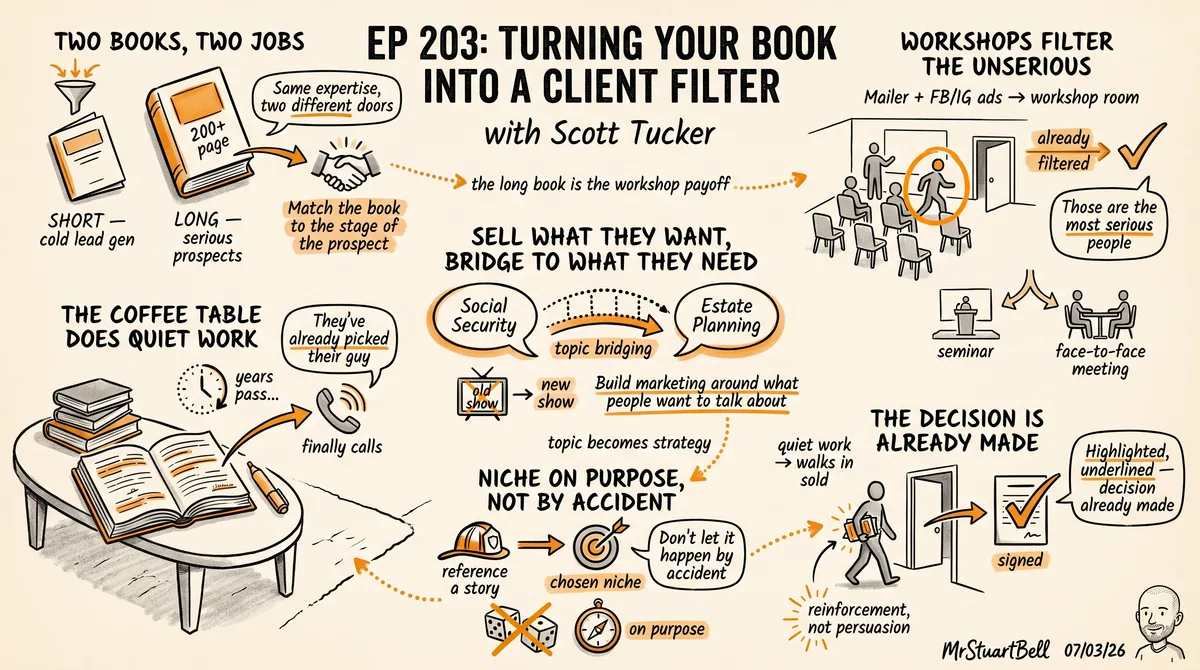
- Match your book's length to the stage of the prospect: short for cold lead gen, long for someone already leaning in.
- Workshop attendees convert better because getting them in the room already filtered out the unserious ones.
- A book on the coffee table does ongoing work even when the prospect isn't ready to act yet.
- Build your marketing around a topic people already want to talk about, then bridge to what they actually need.
- Don't let something happen by accident that you could make happen on purpose, apply that to your niche targeting too.
- People who bring your book to the meeting, highlighted and underlined, have already made their decision before they walk in.
Scott Tucker runs a federally licensed retirement planning practice out of Chicago, and he's built his entire client pipeline around two books he wrote for two very different jobs. One is short and built for lead generation. The other is over 200 pages and built to answer every question a serious prospect might have before they ever sit down with him.
What I liked about this conversation is how deliberate Scott is about matching the tool to the job. His workshop attendees are already serious, so they get the deeper book. His Facebook and radio audience needs a lighter hook, so they get the shorter one. Same expertise, two different doors into it.
We also got into something every high-trust business owner deals with: people don't act on your advice the moment they need it, they act when procrastination finally runs out. Scott talked about clients who first heard from his office years ago and are only now getting around to calling. His book sits on their coffee table the whole time, doing quiet work, reminding them they already picked their guy.
If you've ever wondered whether your book needs to be a hundred pages or ten, this is a good listen. Scott makes the case for having both, and using each one on purpose instead of by accident.
Transcript
AI transcript provided as supporting material and may contain errors.
Stuart: Hey, everyone. Welcome back to the show. It's Stuart Bell here, and today we have Scott Tucker. Scott, how's it going, buddy?
Scott Tucker: Oh, very well. Thank you
Stuart: Fantastic. I'm, excited to run through this because your cover, which I'll put a link to in the show notes so people can see it, but the cover of your book's fantastic because it just so clearly cuts through the noise of what it does.
Scott Tucker: Our company's in Chicago. we do, we are federally licensed, so we can help folks all throughout the United States and its territories, green card holders, and citizens. being in Chicago, most of our clients are in Chicagoland, but we have, clients in Florida, Texas, California, Michigan, Wisconsin, or wherever else.
Stuart: How's that-
Scott Tucker: Yeah?
Stuart: How's that one compared with the seminars, the education events?
Scott Tucker: the peo- the people that go to a workshop, what's really great about them, you know, you have to do, you have to mail, do a mailer, and you have to do the- the Facebook and Instagram ads and all that. What's really good about once you get somebody to the workshop, those are the most serious people. Those are the people that are gonna go somewhere. And so what's really good about them, they're more likely to go somewhere again, to go to our office, have a face-to-face meeting.
Stuart: Yeah. What's the... We've had a few clients who do the, particularly financial services, who do like the look live type, just short, two-minute slots. I don't think I've ever heard anyone talking about the longer, 30-minute long duration pieces. So is that kind of like a, Naval Ravikant type- How to make you rich, like a deep dive with individual people?
Scott Tucker: all of the
Stuart: episodes or- oh, like the,
Scott Tucker: like the format of the show?
Stuart: yeah.
Scott Tucker: So, the show, what's been really hot in financial planning, retirement planning, it used to be Social Security, and Social Security timing, Social Security techniques, and all this sort of thing.
Stuart: Yeah.
Scott Tucker: So the TV show is gonna be focused, on estate planning primarily.
Stuart: And that switch between kind of like the baby boomers to Gen X going from Social Security to estate planning, is that ... How much of that do you think is just Gen X not necessarily believing in Social Security because they've been told all their life- ... that it's about to run out next week, and-
Scott Tucker: Oh ...
Stuart: maybe their financial- Yeah
Scott Tucker: Social Security, something nobody ever talks about, s- the millennials, and we'll say they're roughly 40 to 20 years old, so that's just to give us round numbers.
Stuart: Right. It's actually a good demonstration as well of an idea that we talked about a few times, this idea of selling people what they need- And, sorry, selling people what they want and delivering what they need, this separation between, I call it topic bridging sometimes, like the conversation that's going on and the ultimately the thing that actually has to happen might not really be the exact same thing.
Scott Tucker: There is a bit of, what is the sexy object? What is the bait that the people will... You know, we're gonna- we wanna go fishing for a certain type of fish, what kind of bait do we use? Right. Social Security has gotten us the right people over the years because it's getting those people 62 to 70, and that's prime time for us.
Stuart: Yeah, it is what it is. Yeah ...
Scott Tucker: and, so a lot of folks that have a financial planner, maybe they have an Edward Jones or Chase Bank or, Schwab or whatnot, those employees of those big box firms c- have a gag order what they can talk about.
Stuart: How many people across the board- Have any idea of the breadth of the problems that are out there? kind of get- trying to get to kind of the, is it an unknown problem or a known problem?
Scott Tucker: Well, I ask you, where did you go to school when you were a kid? What country?
Stuart: UK. Yeah. The UK. So I was in the UK until 10 years ago
Scott Tucker: And, when you say UK, do you mean England specifically?
Stuart: Wales and England.
Scott Tucker: Wales?
Stuart: Yeah.
Scott Tucker: Oh, you're Welsh.
Stuart: yeah.
Scott Tucker: So when you were growing up... Just out of curiosity, when I was in the Navy, I was stationed in Scotland for two years, so I- Oh,
Stuart: okay ...
Scott Tucker: have a little bit of familiarity with the neighborhood. Yeah. so when you were growing up in Wales, did the, did your teachers, did they teach you a lot, all the financial stuff you needed to know?
Stuart: No. And in fact, I don't think there was any real-
Scott Tucker: It's almost like a conspiracy, isn't it?
Stuart: yeah.
Scott Tucker: it's, there are people in the know and the people in the not, right? When I grew up- Yeah ... I went to public school in, in Dewitt, Michigan, and very good public school system. It was very heavily focused on sending all the kids to college, which kind of now we scratch our heads and say, "Why would we do that?"
Stuart: it- Maybe teachers then left.
Scott Tucker: Yeah. the teachers back then- I don't recall the teachers back then having a deferred comp lo- program. I believe when I was growing up, all they had was a pension, and they had good pensions.
Stuart: compete you
Scott Tucker: with their solid pension. Just go, "Why don't you go..." They go, "Why don't you go to Michigan State and get a degree in English?"
Stuart: job and put
Scott Tucker: your head
Stuart: down and- Yeah,
Scott Tucker: there... There, you might be familiar with High Point University.
Stuart: much of, how much of it is, how much does the window close as people get closer and closer to the Either passing away at the end of life time kind of thing. But is there, is it definitely the case that people would be better served by doing this sooner rather than later?
Scott Tucker: Yeah.
Stuart: Like, is time a component that you really start running out of options as the window narrows?
Scott Tucker: Yeah. We had a client, lived nearby the office. the, a few months ago she passed away at 93, and she was running... The Illinois state tax affects you if you go one, if an individual or a couple was one penny over a $4 million net worth.
Stuart: Yeah. How often do those things change? Like, if people have made a plan five years ago, is it this...
Scott Tucker: I think it's sort of like a garden because you need to pull the weeds. You need to be meeting with your financial planner and that, you know, and your attorney fairly often.
Stuart: Yeah. It is- People who are long-time listeners know my background is on the project management side of financial services back when I had a career years ago.
Scott Tucker: Yeah, you gotta kind of listen to yourself and see, you know, just a lot of sales experience, and you see what resonates and what doesn't.
Stuart: yeah.
Scott Tucker: there's also, one of the biggest things we face is procrastination. So we'll m- meet with people and we'll show them what we can do, and there's...
Stuart: Yeah. That one probably, I mean, we have the same, but doing this for- 13 years or so now. And then we've got people who probably reached out to us at the same time that you wrote your first book and now are just having the conversation, "Oh, I really need to get around to doing that."
Scott Tucker: there's a funny thing that has happened recently about a week or two ago.
Stuart: Right ...
Scott Tucker: it's modeled data, but it's pretty accurate. And, so then we would like fax, we'd try to get them on the phone calendar, we'd fax them a book and stuff.
Stuart: Yeah
Scott Tucker: And
Stuart: that, right, and that point, man, if any- everyone who's listened to this, I mean, 'cause- the listeners, this mainly are people who are on our list and have thought about a book at that point or at some point or other.
Scott Tucker: Yeah.
Stuart: And so many people miss that because we're seeing it from the inside. Like, everyone who works in the office sees all of the books and all of the channels and all the TV stuff, and you could be something to a broad swathe of people, and forget to see it from the way that people are coming in.
Scott Tucker: We had the phone meeting with a gentleman from Cleveland, and I have, like, five monitors here, you know. So I- He go, he goes, he goes, "Yeah, so I get the deferred comp program, through the department."
Stuart: yeah.
Scott Tucker: I go, "Oh, yeah, and you gotta go down there and tell them what for one day a year."
Stuart: Cause they all do. yeah. Yeah. Yeah. '
Scott Tucker: Cause I've been to the plum- I've been to the plumbers hall here in Chicago and they have for a charity thing and they have a bar.
Stuart: So- It's like the UK equivalent would be, like, working men's clubs, which again is probably a bit of a thing of the past now, but that would be the same. Like, all of the miners, the- ... place to go would be the place that had the bar. And there was a bit of union shop talk first, but then let's get
Scott Tucker: to the
Stuart: important
Scott Tucker: business- Well, you're a-
Stuart: of drinking.
Scott Tucker: You're a many, in many states in the US you have to belong to the union to be able to get the job. So-
Stuart: Right ...
Scott Tucker: call it closed shop. So in Illinois, Illinois is a, closed shop state. You have to, if you wanna work- Okay ... for like Chicago Fire Department, you have to join the union. Yeah. Other states they've gotten rid of that and they've come up with right to work, laws, but still the unions are very powerful, especially in, northern states.
Stuart: Right. Yeah. You know? And that type of kind of chess playing of thinking, "Okay, there's a world full of pieces, but which of the moves or which of the pieces are grouped together to make the most sense?"
Scott Tucker: I told you before we started recording, I was, a kind of a Dan Kennedy, fan. Yeah. You've heard my origin story and all this, of sorts. And so he had a thing, he said that, anything that happens on accident, see, make it happen on purpose. So we would randomly get a fireman come in with a million bucks, and it's like, well, gee, you know, why don't we just become the financial advisor for the fireman?
Stuart: Right ...
Scott Tucker: you know, instead of just, you know, hoping anything that happens on accident, see if you can make it happen on purpose. one of the best uses of one of the 90-minute books is, lead generation. So it can be Facebook ads, Instagram ads, for your book, and you have a landing page, and you collect their information, and give them a digital download.
Stuart: And that idea of how you're actually using it, again, we talked about it a few times, the idea that you've got multiple delivery mechanisms.
Scott Tucker: When
Stuart: they- ... physical ...
Scott Tucker: well, yeah, oftentimes when they come in they bring the book with them too.
Stuart: Highlighted and underlined.
Scott Tucker: Yeah, they have like... Yeah, in the, the Escape Illinois book, I just kept it brief and gave the essential information.
Stuart: It's
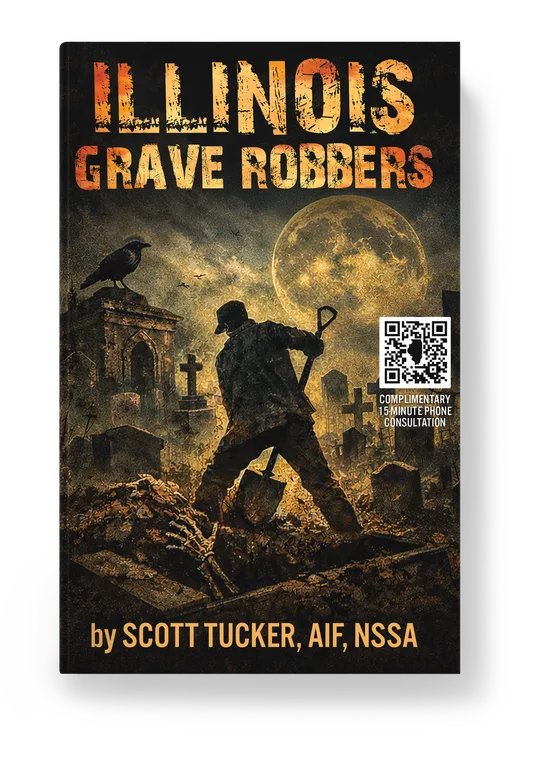
Scott Tucker: done well. We do als- we also do have a radio show where we offer it, and we get some folks to go to a website to get that there. the, Illinois Grave Robbers book is just over 200 pages.
Stuart: Ah, okay.
Scott Tucker: So they don't trigger, they don't expel funds and create ta- unnecessary taxes.
Stuart: It's that people make the decision that, okay, I think that Scott's the person I wanna work with. I'm confident in my decision. I just wanna get through to the finish line with nothing evidencing that I've made a bad decision. I kind of want that reinforcing point that I've made a good decision, and the book is an element.
Scott Tucker: Have you ever had something around the house you wanted to fix and you order the thing to fix it on Amazon?
Stuart: Right. yeah
Scott Tucker: And then, and it just sits there. It's the same thing. Right. They say, "Oh, magic, magic widget. I'm concerned- Yeah ... about the Illinois estate tax.
Stuart: quick read. "Oh, I can just... I just call Scott. Let me do
Scott Tucker: that instead" then they look at it like, "Oh, yeah, Illinois estate tax. Oh, it's gonna be a problem."
Stuart: Right.
Scott Tucker: You... If you're, if you die in Illinois, you and your spouse die in Illinois right at 4 million, you... No tax to the state of Illinois for Illinois estate tax. If you go one penny over, then you could send about $285,000 to the state of Illinois for estate tax. Right. And it goes up from there.
Stuart: And those cliffs are...
Scott Tucker: Ill- Illinois, if you go one penny over, they tax the entire estate.
Stuart: Yeah.
Scott Tucker: So there's a thing we call a, Tucker Shelter Trust that we can set up for couples, it only works for couples, to get what's called portability.
Stuart: Right.
Scott Tucker: and then beyond that, if you're concerned about you're gonna get...
Stuart: Yeah. And it's one of those areas where there's so... it's a rabbit hole of, rabbit warren of it depends for each individual person.
Scott Tucker: I think it'll be about three months. We're gonna have it on T- on the new TV shows out. They have to go through editing and things.
Stuart: Nice.
Scott Tucker: Our website is scotttuckersolutions.com. So scotttuckersolutions.com.
Stuart: Perfect. And as always, I'll put a link... I'll actually put all of the covers for the books in the show notes so people can see them, and then straight below that I'll put the link to the website so people can follow through. it... I love these shows because it's good to see people actually using them.
Scott Tucker: Thank you. Yes.
Stuart: All right, brother. Well, thank you. Thanks for your time. we'll catch up with you soon. Everyone, th- thanks for listening. K- definitely check out the show notes 'cause there'll be some good links in there, and then we'll catch everyone in the next one.
Scott Tucker: Thanks so much.