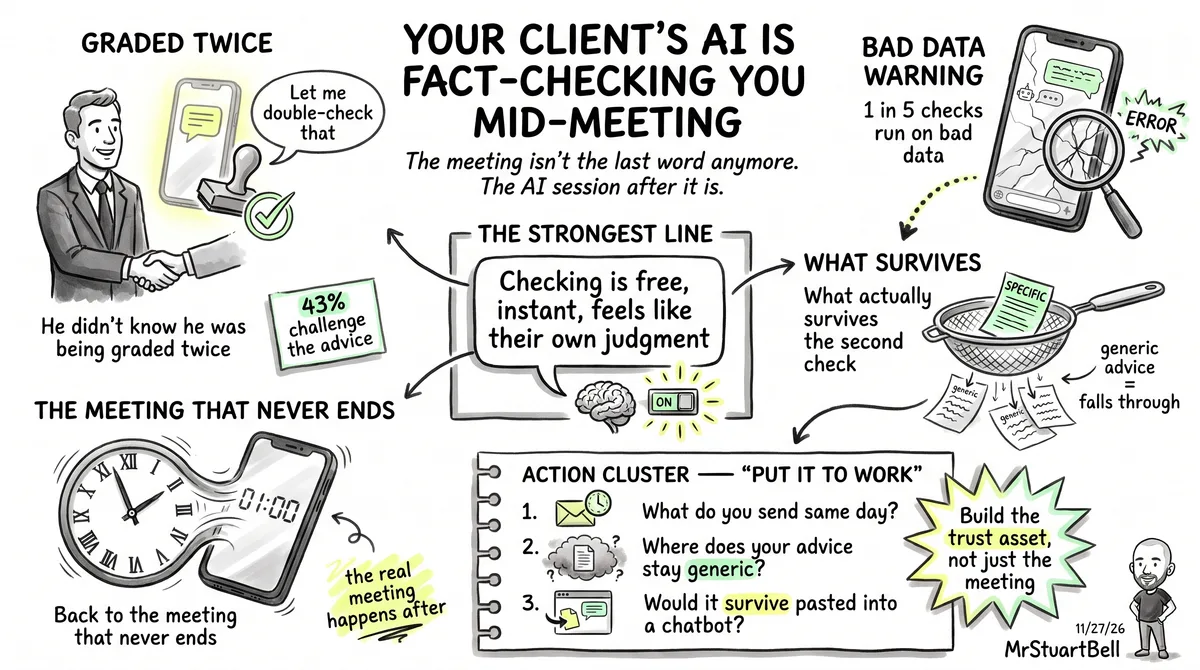
The meeting isn't the last word anymore. The AI session right after it is.
Pacific Life surveyed financial advisory clients in October and published something most advisors haven't registered yet. The survey, reported by InvestmentNews on October 27, found that clients aren't just researching an advisor before the call. They're grading the advisor again right after it, through a tool the advisor never sees.
43% of clients now use AI to validate or challenge the recommendation their advisor just gave them. 42% say AI is their first stop for financial research, ahead of calling a friend or asking a family member.
That's not a prospecting problem. That's a meeting that doesn't actually end when you think it ends.
I worked with a wealth manager a while back who mentioned, almost in passing, that clients kept bringing up how much they liked getting an AI-generated summary after their calls. Bullet points, action items, the works. He hadn't built that in on purpose. It came bundled with his meeting software. He wasn't thinking about it as a trust mechanism. His clients were.
Your client isn't fact-checking you because they distrust you. They're fact-checking you because checking is free, instant, and feels like their own judgment, not a betrayal of yours.
He didn't know he was being graded twice
That wealth manager's experience is Delegation 2 of what I call the Agentic Trust Loop. The client researches you with AI before they ever call, which is a habit I wrote about back in March. They sit across from you and make a judgment call in the room. Then, sometimes before they've left the parking lot, they loop AI back in to check whether what you told them holds up. You're not in the room for that third pass. You can't clarify, soften, or add context mid-stream. The recommendation stands or falls on its own, read back by a machine that has no idea what your tone of voice was doing while you said it.
I've written before about this exact moment showing up in individual client stories. What Pacific Life just did is put a number on how often it happens across an entire industry. Forty-three percent isn't a few cautious outliers checking their advisor out of habit. It's close to half.
One in five of those sessions is working from bad data
Here's where it gets uncomfortable. Pacific Life's data shows roughly one in five of those post-meeting AI sessions runs on inaccurate information. Which means you're not always defending your advice against a skeptical client. Sometimes you're defending it against a chatbot's mistake, and the client has no way to tell the difference. They just know the AI said something that didn't match what you said, and now there's a gap somebody has to close.
This is the part advisors miss. Clients aren't running these checks because something went wrong in the meeting. They run them because checking costs nothing. Open the app, paste the recommendation, ask if it makes sense. It takes less time than deciding what to order for lunch. Being legible to AI before the meeting, the Delegation 1 research most advisors are at least aware of now, was never the finish line. It was the opening move.
What actually survives the second check
The advisors who come through a Delegation 2 check intact aren't the ones with the longest résumé. Credentials don't travel into a chatbot conversation. What travels is specificity. A recommendation tied to the client's actual numbers, actual timeline, actual goals, said clearly enough that it still holds together when a client pastes a version of it somewhere else and asks whether it's right.
Generic advice doesn't survive that test. "Diversify your portfolio" gets picked apart by any AI with access to a search engine. "Given your $340,000 rollover and a six-year runway to retirement, here's why we're weighting bonds this way" is harder to contradict, because it isn't a generic claim. It's reasoning the client can follow and repeat back, even to a machine.
What you leave behind matters just as much. A short written recap in your own words, sent the same day, gives the client something accurate to check their AI session against instead of the other way around. If the only record of your advice is the client's memory of the meeting, you've handed the AI session the whole job of reconstructing what you said. Reconstruction from memory is exactly where the errors Pacific Life measured creep in.
Back to the meeting that never ends
So the meeting isn't the finish line. The AI session after it is one more conversation you're having, just one you weren't invited to. You don't get to sit in on it. You do get to decide how much of yourself you leave behind for it to work from.
Put it to work
What do you send the client the same day?
A short written recap, in your words, tied to their specific numbers. Give their AI something accurate to check against instead of their memory.
Where does your advice stay generic?
Find the line in your pitch that could apply to any client, and rewrite it so it only makes sense for this one.
Would your recommendation survive being pasted into a chatbot?
Say it out loud, then ask if it holds up without you standing there to explain it.